Plan consumer revenue, retention and payback.
Match the model to how you earn.
Consumer businesses make money in very different ways. Choose DTC and retail, a consumer app, or a subscription. Each one carries the acquisition, retention and payback maths for that model.
Marketing $18k a month across 4 channels, AOV $42, 2.8% conversion, 34% repeat rate
Three of four channels pay back within 5 months.
- Paid socialLargest channel. CAC rising as spend scales.$34+$6Payback 5 mo
- SearchSteady intent traffic, highest first-order value.$26Payback 3 mo
- ReferralCustomer referral credit. Smallest, cheapest channel.$12-$2Payback 1 mo
- InfluencerRepeat rate too low to recover the cost quickly.$58Payback 14 mo
Startup Suite is an AI planning workspace that helps consumer founders model acquisition by channel, retention and payback.
This page is for consumer founders deciding how to plan DTC and retail, a consumer app or a subscription.
- Acquisition by channel
- Repeat purchase & retention
- Pricing & LTV
- CAC by channel
- Cost of goods & fulfilment
- Retention & loyalty spend
- Cohort LTV & payback model
- Channel-mix plan
- Consumer growth model
- Forecast Engine
- Scenario Workbench
- AI mentors
Where consumer growth gets expensive
CAC keeps creeping up
Acquisition gets more expensive and you can't see when it stops paying back.
Retention is a black box
You know who bought once, but not how many came back or what a returning customer is worth.
Channel ROI is a guess
Spend is spread across channels with no clear read on which actually works.

See what changes when your consumer assumptions move
Edit CAC and retention and watch LTV, payback, and channel ROI recompute, then test a CAC increase against a retention improvement.
Model acquisition by channel, repeat purchase and retention into cohort LTV, so you can see how long each channel takes to earn back what it cost.
- Assumptions
- Model
- Scenarios
- Mentor Review
- Outputs
AI mentorCurrent acquisition and retention: LTV clears CAC with a payback under five months.
One model, connected from the first input to the final output
Change CAC by channel or repeat rate and LTV and payback rerun. A CAC rise sits next to better retention, and the mentor flags the channel that stops paying back.
Edit CAC by channel and repeat rate
LTV, payback, and contribution recompute
Compare base, CAC-up, and retention-up
Flags the channel that stops paying back
Consumer growth model
Illustrative example.
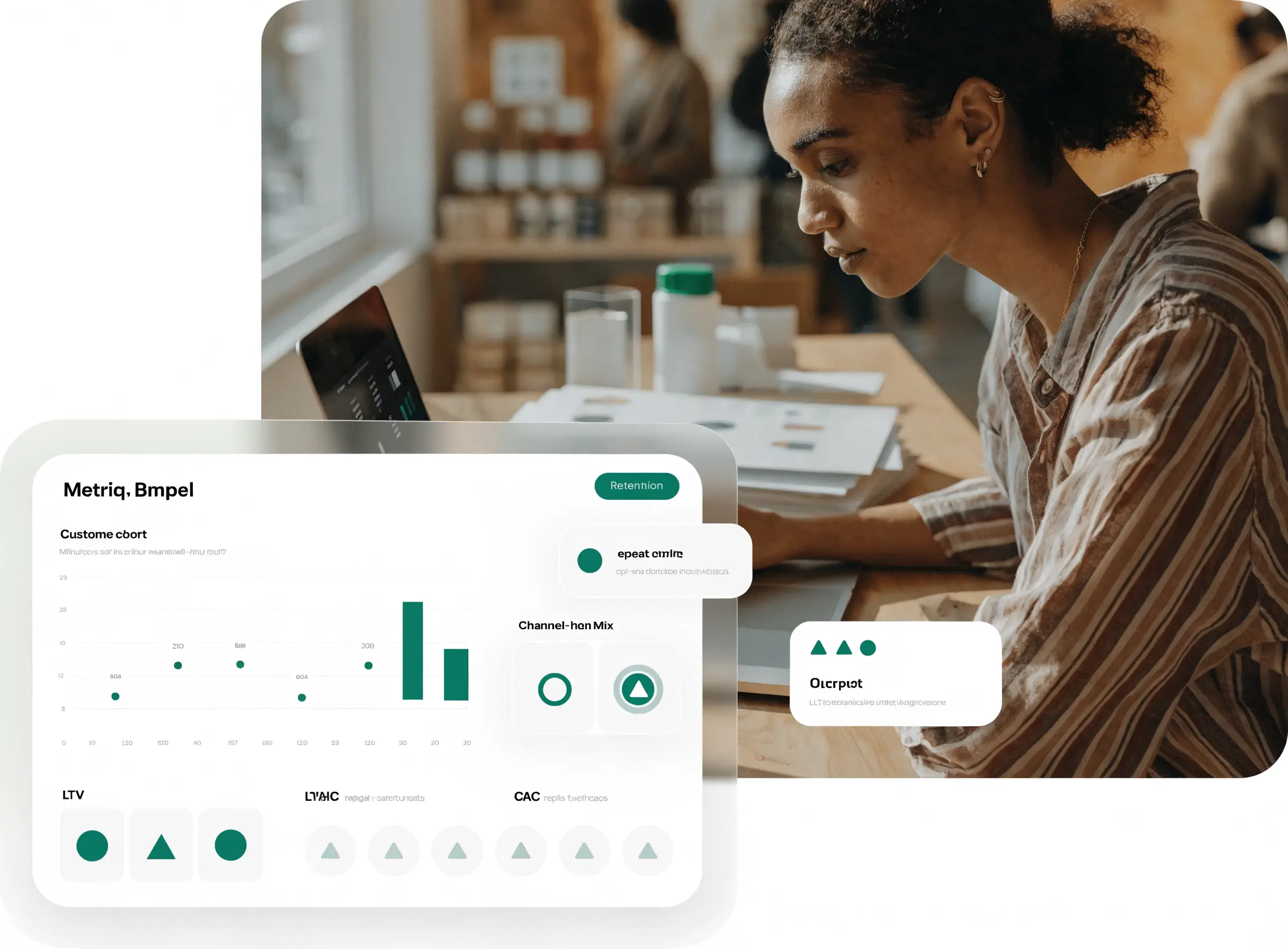
The most common B2C starting point
Physical goods, apps or subscriptions: each one earns back its CAC differently.
Physical products sold to consumers, where returns and stock decide the margin.
- DTC & retail
- Consumer app
- Subscription & membership
Channel, price, and spend calls you can make
Each one judged by how long a customer takes to pay back what they cost.
Pick the B2C model that fits how you earn
DTC & retail
You ship a physical product. Use the e-commerce model.
Consumer app
Your product is an app with installs. Use the mobile-app model.
Subscription & membership
Customers pay a recurring fee. Use the SaaS model for the churn maths.
Still deciding
Whatever the model, plan CAC, repeat purchase, LTV and channel payback here first.
From ad spend to lifetime value
- Step 1
Bring in ads & sales
Enter or connect spend and orders by channel.
- Step 2
Set CAC & repeat
Acquisition cost and repeat behaviour per cohort.
- Step 3
Model LTV
Retention and pricing roll up into lifetime value.
- Step 4
Optimise the mix
Put budget where payback is strongest.
More than a spreadsheet, more than a consultant
| Feature | Spreadsheetthe old way | Consultantquoted per model | Startup Suiteconnected workspace |
|---|---|---|---|
| CAC and LTV per channel (not blended) | Manual | ||
| Cohort retention drives lifetime value | Hard | ||
| Scenario compare (CAC / channel / retention) | Tabs | On request | |
| AI mentor explains the payback risk | Hourly | ||
| Consumer growth model output |
- CAC and LTV per channel (not blended)
- Manual
- Cohort retention drives lifetime value
- Hard
- Scenario compare (CAC / channel / retention)
- Tabs
- AI mentor explains the payback risk
- Consumer growth model output
- CAC and LTV per channel (not blended)
- Cohort retention drives lifetime value
- Scenario compare (CAC / channel / retention)
- On request
- AI mentor explains the payback risk
- Hourly
- Consumer growth model output
- CAC and LTV per channel (not blended)
- Cohort retention drives lifetime value
- Scenario compare (CAC / channel / retention)
- AI mentor explains the payback risk
- Consumer growth model output
Pick the version closest to your business
E-commerce / DTC
Physical products sold online: model true margin, inventory and acquisition payback.
Sample output: Margin & cash model
See the E-commerce / DTC modelConsumer apps
Mobile or web apps: model installs, retention and LTV/CAC across each way the app earns.
Sample output: App-economics model
See the Consumer apps modelSubscriptions
Recurring consumer revenue: model churn, repeat and lifetime value the way a SaaS company would.
Sample output: Recurring LTV model
See the Subscriptions modelRetail
Physical stores and stockists: model foot traffic, basket size and per-location economics.
Sample output: Per-location model
See the Retail modelCreator-led
Audience-driven products and memberships: model conversion from reach to recurring revenue.
Sample output: Creator revenue model
See the Creator-led modelLocal consumer services
Bookings and capacity-based consumer services: model utilisation and repeat custom.
Sample output: Utilisation model
See the Local consumer services modelConsumer business planning questions
Do you model CAC and LTV by channel?
It's built to. Acquisition cost, repeat purchase and retention are modelled per channel and cohort, so you can see each channel's payback period.
Can I see which channels pay back?
It's designed to. Channel mix and payback are modelled, so you can shift budget to the channels that earn it back.
What is a B2C financial model?
It models customer acquisition by channel, repeat purchase and retention into cohort LTV and payback, so the money you spend to grow is tied to what it returns.
Is this just a spreadsheet template?
No. Most templates use one blended CAC. Here each channel has its own CAC and repeat rate, so a rise in paid social costs shows up in that channel's payback first.
Which B2C model should I use?
Pick by how customers pay. Paying per order points to the e-commerce model, paying inside an app to the mobile-app model, and a recurring fee to the SaaS model. If you're unsure, start here with CAC and repeat rate by channel.
Related business models
See all solutionsGrow spend only while it pays back
Enter CAC by channel and your repeat rate, and see lifetime value and payback on your own customers.