For e-commerce brands.
Margin, inventory, and cash that tie out.
Inventory, shipping, returns, seasonality and ad spend in one model, so the forecast shows when cash leaves for stock and when it comes back.
AOV $64, product cost $23, shipping $6.50, 9% return rate, 2.4% conversion
Margin holds after returns. Stock ties up cash into Q1.
- Net unit marginAfter COGS, shipping, payment fees and returns.$27Per order
- Ad cost per orderPaid social and search, blended across new and repeat.$9+$1vs last plan
- Repeat rateCustomers placing a second order within 12 months.28%+3ptBy cohort
- Cash in stockQ4 reorder lands 45 days before peak sales.$46kPeak in Oct
Startup Suite is an AI planning workspace that helps e-commerce founders model true unit margin, inventory, and working capital, so the forecast shows when cash is tied up in stock.
This page is for e-commerce and DTC operators modelling margin, inventory, and cash.
- Orders & AOV
- Repeat purchase rate
- Channel & promo mix
- COGS, shipping & payment fees
- Returns
- Inventory & working capital
- True unit-margin model
- Inventory & cash-flow plan
- Cash-flow forecast for a lender
- Forecast Engine
- Scenario Workbench
- AI mentors
Where e-commerce margin goes missing
Returns and shipping eat the margin
Gross margin looks healthy until returns, fees and freight come out of each order.
Cash is trapped in inventory
You're profitable on paper but can't make payroll because it's all sitting in stock.
Seasonal stock is paid for early
A Q4 reorder is paid for before peak and sold through after it, and a flat monthly plan hides the cash gap in Q1.

See how Startup Suite models e-commerce margins
Edit COGS, returns, and ad spend and watch true unit margin and cash recompute, then see what a free-shipping or supplier-cost scenario does.
Deduct COGS, shipping, fees and returns to find the margin you keep, then tie inventory to cash timing in a model you can take to a lender.
- Assumptions
- Model
- Scenarios
- Mentor Review
- Outputs
AI mentorCurrent margins and cash timing: contribution covers acquisition with runway to spare.
One model, connected from the first input to the final output
Change the returns rate or shipping cost and unit margin and cash rerun. Free shipping sits next to base, and the mentor flags when ad spend stops paying back.
Edit returns rate and shipping cost
True unit margin and cash recompute
Compare base, free-shipping, and supplier-cost +15%
Flags when ad spend stops paying back
Cash-flow forecast for a lender
Illustrative example.
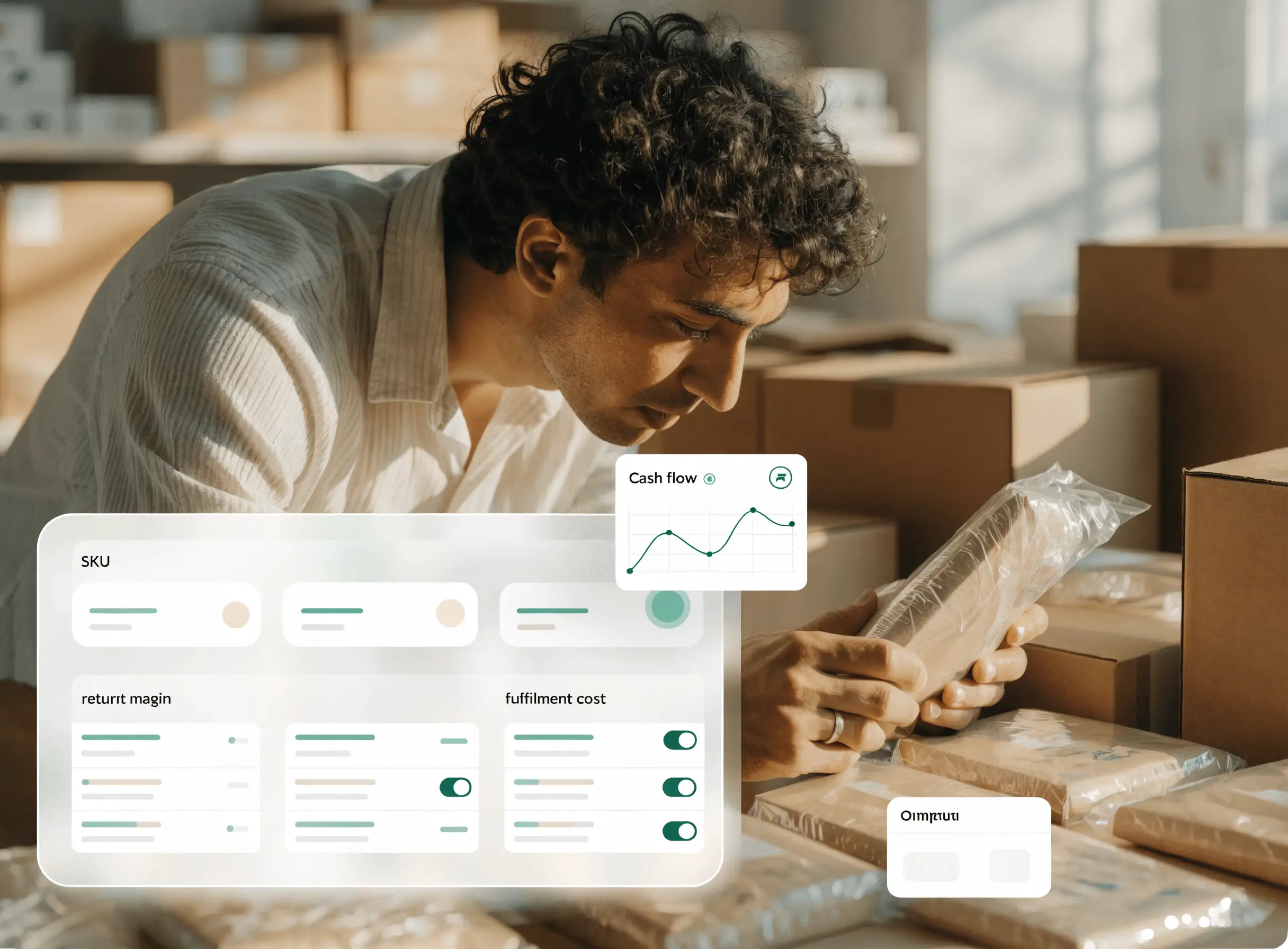
Where the margin on an order goes
What an order is worth after everyone is paid.
Gross margin rarely survives returns, freight and payment fees. This model follows each order through to what is left.
- True unit margin
- Inventory & working capital
- Seasonality
Stock and spend calls based on real margin
Buying, range and ad-budget calls, each judged on margin after returns and fees.
What the e-commerce model covers
True unit margin
COGS, shipping, payment fees, and returns netted out to show the margin you actually keep.
Inventory & working capital
Model the cash tied up in stock and the timing of when it comes back.
Seasonality
Model demand and stock month by month, so peak-season buying shows up in the cash plan.
Acquisition & contribution
Tie ad spend to contribution margin, so you can see when growth starts losing money.
From orders and ad spend to a cash view
- Step 1
Bring in sales & ads
Start from your order and ad-spend figures, and add payment data from a read-only connection such as Stripe or Polar when one is available.
- Step 2
Set unit economics
COGS, shipping, returns, and fees per product line.
- Step 3
Model the season
Map demand and inventory across the calendar.
- Step 4
See the cash
Watch working capital and runway move with each decision.
More than a spreadsheet, more than a consultant
| Feature | Spreadsheetthe old way | Consultantquoted per project | Startup Suiteconnected workspace |
|---|---|---|---|
| True unit margin (COGS, shipping, fees, returns) | Manual | ||
| Inventory & working-capital cash timing | Hard | ||
| Scenario compare (returns / free-ship / channel) | Tabs | On request | |
| AI mentor explains the cash risk | Hourly | ||
| Cash-flow forecast for a lender |
- True unit margin (COGS, shipping, fees, returns)
- Manual
- Inventory & working-capital cash timing
- Hard
- Scenario compare (returns / free-ship / channel)
- Tabs
- AI mentor explains the cash risk
- Cash-flow forecast for a lender
- True unit margin (COGS, shipping, fees, returns)
- Inventory & working-capital cash timing
- Scenario compare (returns / free-ship / channel)
- On request
- AI mentor explains the cash risk
- Hourly
- Cash-flow forecast for a lender
- True unit margin (COGS, shipping, fees, returns)
- Inventory & working-capital cash timing
- Scenario compare (returns / free-ship / channel)
- AI mentor explains the cash risk
- Cash-flow forecast for a lender
Pick the version closest to your business
DTC brand
Own-site sales with paid acquisition: model contribution margin after CAC, returns and fees.
Sample output: Contribution-margin model
Marketplace seller
Third-party marketplace channels: model referral fees, fulfilment costs and channel-level profit.
Sample output: Channel P&L
Subscription box
A recurring physical product: model churn, replenishment and inventory against recurring revenue.
Sample output: Recurring margin model
See the Subscription box modelRetail & wholesale
Stockists and wholesale accounts: model landed cost, markups and payment terms across channels.
Sample output: Wholesale margin stack
E-commerce modelling questions
Do you handle returns and shipping in margin?
It's designed to. COGS, shipping, payment fees and returns are all deducted to give a true unit margin, which is usually well below gross.
Can it model inventory and working capital?
It's built to. The cash tied up in stock and the date it comes back are modelled, so runway accounts for reorders as well as profit.
What is an e-commerce financial model?
It projects revenue and the margin you keep after COGS, shipping, fees and returns, then ties inventory and working capital to cash timing so profit and cash both make sense.
Is this just a spreadsheet template?
No. A template holds fixed formulas. Here, changing returns or shipping reruns margin and cash, and you can compare a free-shipping case against base before you commit.
What outputs does it produce?
It's built to produce a true unit-margin model, an inventory and cash-flow plan, and a financial model to take to a lender. Every figure traces to an assumption.
Related business models
See all solutionsSee the margin your store actually keeps
Enter your product costs and return rate, and see what each order leaves you and when stock cash comes back.