How Long Will Your Money Last?
Cash runway tells you how long your business can keep operating before it runs out of cash at its current burn rate. The formula is cash on hand divided by net monthly burn: $180,000 in the bank at a $15,000 net burn gives 12 months. Use net burn rather than gross burn, because revenue changes the picture.
· Updated · 5 min read

On this page
- Runway equals cash on hand divided by net monthly burn.
- Net burn (spend minus the cash customers pay you, leaving out investment and loans) is the number to divide by.
- Runway is a living figure: recalculate it whenever pricing, headcount, collections, or large costs change.
- A few connected decisions, like trimming spend and improving collections, can add many months of operating time.
Gross burn, net burn and the runway formula
Gross burn is your total monthly cash outflow. Net burn subtracts the cash customers pay you. Money from investors or lenders does not count. The simple runway formula is cash on hand divided by net monthly burn. It assumes burn stays flat, so if you plan to hire, count forward month by month until the cash runs out.
Net burn: Monthly operating spend minus the cash you actually collect in that month. It is the real rate at which your bank balance falls.
If the company has $180,000 in cash and loses $15,000 per month, runway is 180,000 divided by 15,000, or 12 months. If improved collections or lower costs reduce net burn to $10,000, runway extends to 180,000 divided by 10,000, or 18 months.
What runway decides for you
Runway drives hiring, fundraising timing, marketing spend, and vendor commitments. It also determines whether a business has time to learn from the market before it needs more capital. Profit and top-line revenue can look healthy while collection timing, payroll or fixed costs leave far fewer months than expected. Runway turns all of those into one date.
Runway mistakes to avoid
- Using profit instead of cash to judge survival.
- Ignoring one-time payments and large annual obligations.
- Forgetting tax obligations.
- Letting one month of annual prepayments shrink your net burn figure.
- Dividing by today's burn when planned hires will raise it.
Why a spreadsheet runway goes stale
A spreadsheet can calculate runway with one formula. The trouble is that runway matters most exactly where spreadsheets are fragile: when several assumption changes compound across time.
| Feature | Startup Suite | A spreadsheet |
|---|---|---|
| Calculation | Built to connect runway to changing assumptions and scenarios | Calculates a single number with one formula |
| Updates | Designed to keep cash, burn, and scenarios in one workspace | Relies on manual monthly updates |
| Funding gaps | Built to show the gap on a timeline | Harder to see clearly |
- Calculation
- Built to connect runway to changing assumptions and scenarios
- Updates
- Designed to keep cash, burn, and scenarios in one workspace
- Funding gaps
- Built to show the gap on a timeline
- Calculation
- Calculates a single number with one formula
- Updates
- Relies on manual monthly updates
- Funding gaps
- Harder to see clearly
When an accountant's forecast falls short
A consultant or accountant is valuable for fundraising strategy and a review of your finances, but they are usually engaged at specific moments, and the runway figure they hand over is a point-in-time estimate. Weekly and monthly decisions need a runway that updates as revenue and spend change.
Keeping runway current in Startup Suite
Startup Suite's runway view is built as a cash timeline. Instead of asking once how long the cash lasts, you can test which change extends it fastest. Forecast Engine is built to recalculate runway when you change any input behind it.
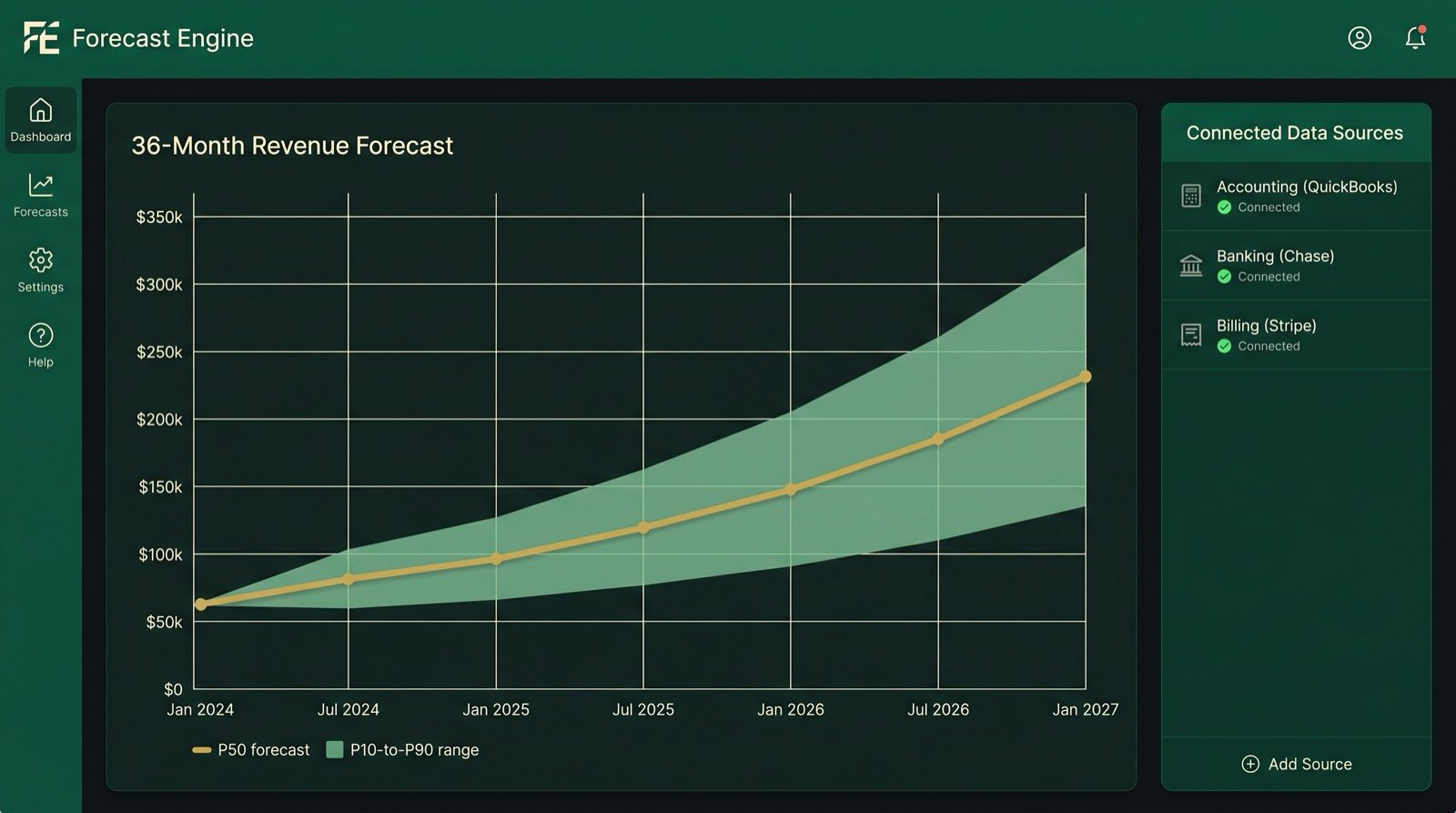
Forecast Engine: a runway that stays current
- Built to show cash, gross burn, and net burn on one timeline.
- Designed for testing a hiring freeze or a collections improvement against runway.
- Meant to surface the funding gap early enough to act on it.
Two changes that add almost a year
Assume a cash balance of $240,000, monthly payroll and overhead of $38,000, and monthly cash collections of $22,000. Net burn is 38,000 minus 22,000, or $16,000. Runway is 240,000 divided by 16,000, or 15 months.
Now test two changes: reduce nonessential spend by $4,000 and increase monthly collections by $3,000. New net burn is 38,000 minus 4,000 minus 25,000, which is $9,000. If both figures hold steady, new runway is 240,000 divided by 9,000, or about 26.7 months.
The takeaway: A few connected decisions added nearly a year of operating time. That is why modelling runway, rather than guessing it, changes what you decide to do this month.
How long will your money last?
Frequently asked questions
What is a good cash runway?
It depends on the business and the funding plan. A common rule of thumb is 18 to 24 months after a raise, and starting the next raise with at least six months left.
Is runway the same as burn rate?
No. Burn rate is the monthly loss of cash. Runway is how long your available cash lasts at that burn rate.
Should profitable companies still track runway?
Yes. Profit and cash timing can diverge. A profitable company can still get into trouble if collections lag or large obligations hit early.
Still have questions? Talk to the team.