When Will You Break Even?
Break-even is the point where total revenue equals total cost. The standard break-even formula divides fixed cost by contribution margin per unit, which gives the units you must sell each month. Your sales forecast then tells you which month you reach that number.
· Updated · 3 min read

On this page
- Break-even is where total revenue equals total cost.
- Break-even units equal fixed costs divided by contribution margin per unit.
- Break-even revenue equals fixed costs divided by the contribution margin ratio.
- Test it under different price and cost assumptions, since both move the line.
Where revenue covers total cost
Founders often talk about getting profitable without calculating the threshold. Break-even makes it concrete: it is the sales level where revenue exactly covers total cost, so every unit beyond it contributes to profit.
Break-even formula: Break-even units equal fixed costs divided by contribution margin per unit (price minus variable cost). For break-even revenue, divide fixed costs by the contribution margin ratio: in the example below, $30 of a $50 price is 60 percent, so $12,000 divided by 0.6 is $20,000 a month.
A break-even number cut off from the forecast
| Feature | Startup Suite | A spreadsheet |
|---|---|---|
| The number | Built to link break-even to the assumptions in your forecast | Can calculate the break-even point |
| Context | Designed to sit inside the full forecast | Often not connected to the full forecast |
- The number
- Built to link break-even to the assumptions in your forecast
- Context
- Designed to sit inside the full forecast
- The number
- Can calculate the break-even point
- Context
- Often not connected to the full forecast
Reviewing the maths versus retesting it
A one-off review checks the formula once. The figure moves every time a supplier raises prices or you change yours, so recheck it then.
Testing break-even in Forecast Engine
Startup Suite's Forecast Engine is designed for testing break-even under different assumptions: change the price or the cost per unit and see how far the point you need to reach moves.
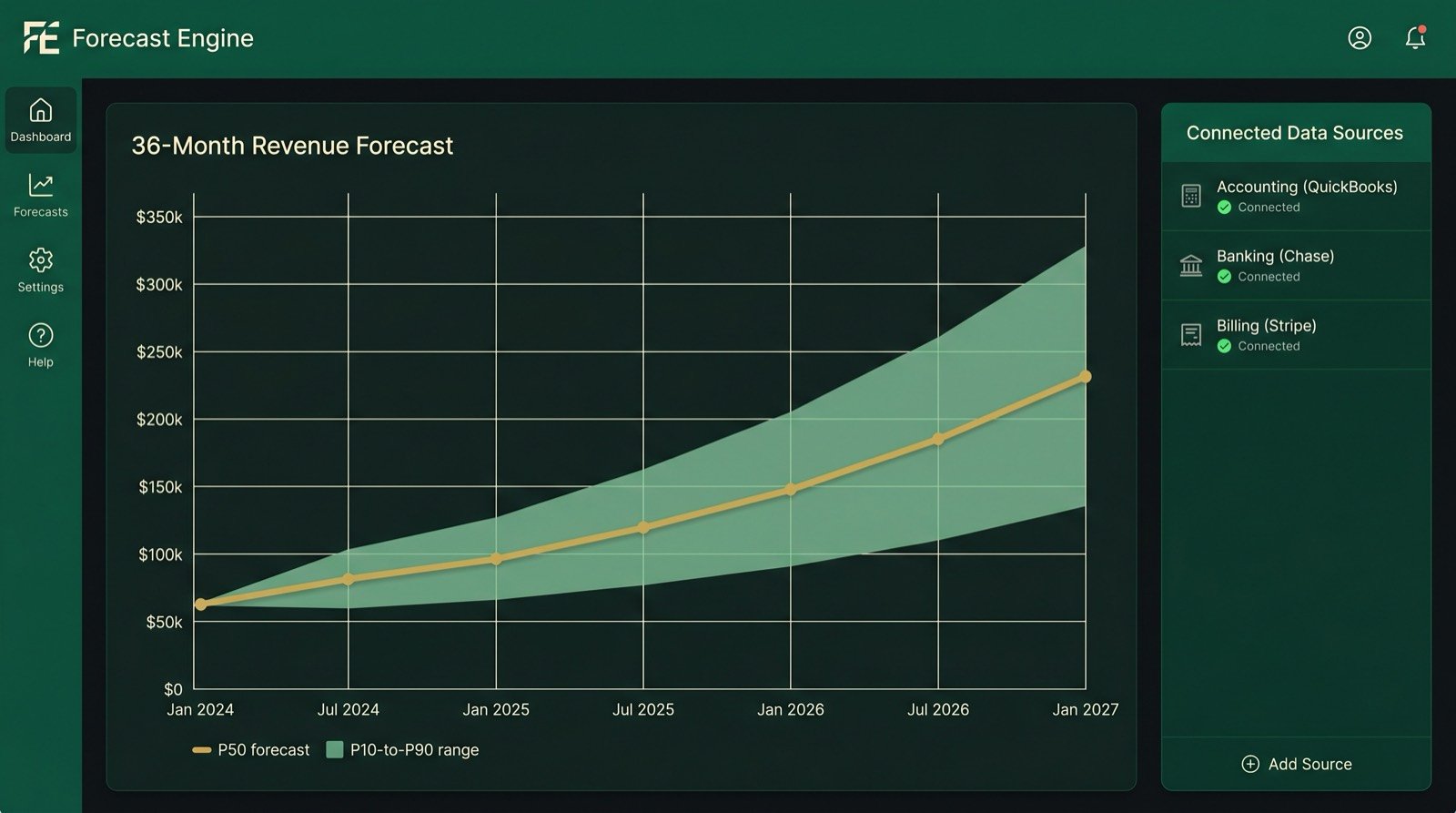
Forecast Engine: break-even you can move
- Built to update break-even units as price or cost changes.
- Designed to connect the threshold to your full revenue forecast.
- Test whether a price increase reaches break-even sooner.
400 units to break even
Suppose monthly fixed costs are $12,000, the price is $50, and variable cost per unit is $20. Contribution margin is 50 minus 20, which is $30. Break-even units are 12,000 divided by 30, which is 400 units a month.
Read it this way: If you sell 250 units this month and add 30 a month, you reach 400 in month 6, assuming price and costs stay flat. Raise the price or cut variable cost and that 400 falls.
When will you break even?
Frequently asked questions
What is contribution margin?
Price minus variable cost per unit, the amount each sale contributes toward covering fixed costs.
Does break-even include all costs?
Yes, all running costs. Fixed costs are the number you divide, and variable costs sit inside the contribution margin. One-off launch costs are usually left out and tracked as a separate payback target.
What lowers the break-even point?
A higher price, a lower variable cost, or lower fixed costs all reduce the units you need.
Still have questions? Talk to the team.