A Business Plan Lenders Trust, Without Finance Experience
If you do not come from finance, the easiest way to make a business plan credible is to connect the story to real assumptions and clear projections. Lenders usually ask for the longer traditional format, where every number in the projections traces back to a stated assumption.
· Updated · 4 min read

On this page
- A plan earns trust when the funding request, the cost list and the projections show the same numbers.
- Lenders check repayment: show that monthly cash flow covers the loan, and what backs it.
- Link the funding request to traceable startup costs and realistic projections.
- Without finance experience, write each assumption in plain words next to the number it drives.
What a lender-ready plan contains
Non-finance founders often think a business plan is mostly words. Then a lender or investor asks for financial projections, startup costs, and the use of funds, and the result is a disconnected document where the narrative says one thing and the numbers say another.
A plan a lender trusts explains the problem and solution, shows who the customer is and what evidence supports demand, and ties the funding request to projections that show the loan being repaid. The list below is the usual lender format, trimmed to the sections a first plan cannot skip.
What lenders are really checking
Lenders are assessing whether they get repaid. They want to know what the business does, how it earns money, what it costs to run, whether monthly cash flow covers the repayments, and what you and any security put behind the loan. A plan that answers those questions in order is far easier to trust.
The sections that matter
For a first strong plan, prioritise these sections:
- Executive summary
- Problem and solution
- Customer and market evidence
- Business model
- Go-to-market
- Operating plan
- Funding request and use of funds
- Financial projections
Why separate finance tabs weaken a plan
| Feature | Startup Suite | A spreadsheet |
|---|---|---|
| Structure | Built to link narrative sections to forecasts | Good for separate financial tabs |
| Assumptions | Designed to make assumptions and outputs easier to explain in context | Easy for non-finance founders to lose track of |
| Output | Designed for structured, lender-ready document assembly | Hard to turn into a clean lender pack |
- Structure
- Built to link narrative sections to forecasts
- Assumptions
- Designed to make assumptions and outputs easier to explain in context
- Output
- Designed for structured, lender-ready document assembly
- Structure
- Good for separate financial tabs
- Assumptions
- Easy for non-finance founders to lose track of
- Output
- Hard to turn into a clean lender pack
What a plan writer can and cannot fix
A consultant or plan writer can improve the wording and add financial polish, and a review at key milestones is useful. The risk is a one-off document you did not build and cannot easily update. You need to understand the plan as you build it, and keep it current as the business changes.
Writing the plan in Business Plan Builder
Startup Suite's Business Plan Builder is designed as a connected planning workspace, so the founder can build the story and the numbers together rather than writing the narrative first and scrambling for projections later.
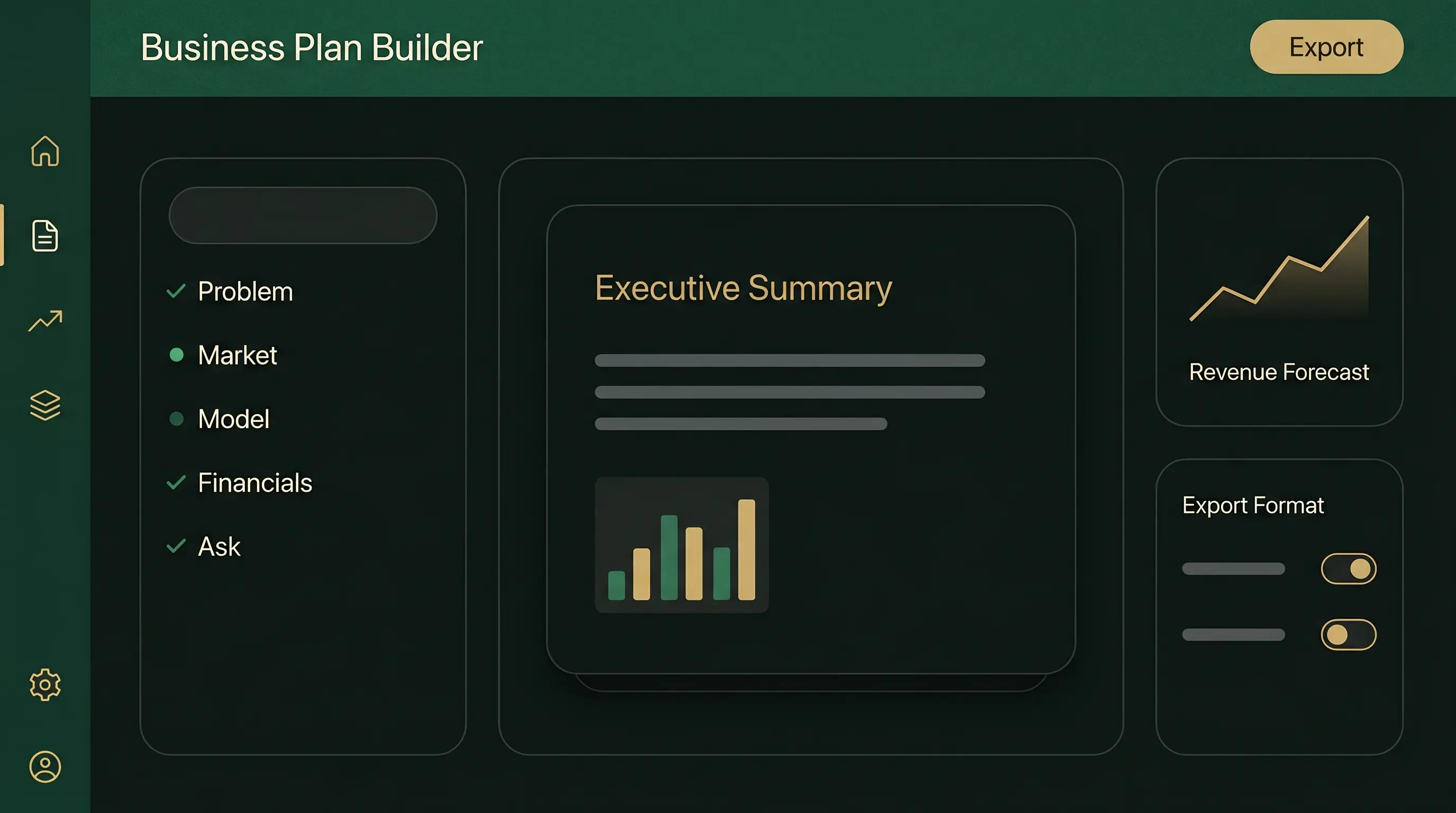
Business Plan Builder: story and numbers in one place
- Designed to start you from a guided outline of lender sections instead of a blank page.
- Built to attach financial projections directly to the funding request.
- Built so the plan can be updated as the business changes, instead of rewritten.
A bakery's $80,000 request, line by line
Suppose a bakery requests $80,000 in funding. The plan should show how the number was built: equipment 35,000, leasehold improvements 20,000, opening inventory 8,000, licences and legal 4,000, marketing launch 3,000, and a working capital reserve of 10,000. Those add up to exactly $80,000.
Why this works: Every dollar of the ask maps to a line item, so a lender can follow the logic. The next thing they look for is the loan repayment inside your monthly cash-flow forecast, with cash still left over.
A business plan a lender will trust
Frequently asked questions
Do lenders want a traditional or lean business plan?
Usually the traditional format. A one-page lean canvas is useful for your own thinking, but a lender will expect full sections and monthly or quarterly projections for the first year.
Do I need a full balance sheet for a small loan request?
Often, yes. Lenders use a projected balance sheet to see what the business owns and owes after the loan. Build it from your P&L and cash-flow forecast so the three agree.
Can I write the business plan before I finish the model?
You can draft it, but credibility improves once the narrative and financials are linked together.
Still have questions? Talk to the team.