Can Your Idea Actually Make Money?
An idea is viable when enough customers will pay a price that covers the cost of serving them and, over time, your fixed costs. You can test that before building anything: estimate demand, price and cost to serve, then work out how many customers you need to break even and how much cash it takes to get there.
· Updated · 4 min read

On this page
- Once demand is proven, viability comes down to two numbers: the customers you need to break even and the cash you need to reach them.
- A break-even check takes an afternoon; finding a thin margin after launch costs whatever you spent building.
- Break-even is necessary but not sufficient; you still need evidence of demand and enough cash.
- If the business cannot plausibly cover fixed costs under realistic assumptions, refine the idea before building a deck.
Five questions that test viability
A founder may have a strong product idea but no clear sense of whether enough customers will pay enough money often enough to build a sustainable business. Without numbers, it is easy to confuse enthusiasm for evidence.
A simple viability check asks five questions:
- Is there demand?
- What will people pay?
- What does it cost to serve them?
- How many customers do you need to break even?
- How much cash do you need before you get there?
Why to test the economics early
The earlier you test the economics, the cheaper the learning is. A break-even check takes an afternoon with a spreadsheet; finding the same thin margin after launch costs whatever you spent building. Run the numbers first, then spend money only on the assumptions that hold up.
Viability mistakes founders make
- Assuming the market is everyone.
- Using a single price point without testing alternatives.
- Forgetting the cost to deliver the product or service.
- Ignoring customer acquisition costs.
- Treating break-even as a vague future milestone instead of a calculable threshold.
Break-even math without the business story
| Feature | Startup Suite | A spreadsheet |
|---|---|---|
| The math | Built to link market assumptions, pricing, and financial outputs | Useful for rough break-even math |
| The story | Built to carry the same assumptions into your forecast | Easy to isolate the math from the business story |
| Auditability | Designed to show the break-even customers and cash needed from your inputs | Harder for non-finance founders to audit |
- The math
- Built to link market assumptions, pricing, and financial outputs
- The story
- Built to carry the same assumptions into your forecast
- Auditability
- Designed to show the break-even customers and cash needed from your inputs
- The math
- Useful for rough break-even math
- The story
- Easy to isolate the math from the business story
- Auditability
- Harder for non-finance founders to audit
Having your assumptions challenged
Ask someone outside the idea to attack the three numbers the result depends on most: price, cost to serve and customers won per month. An advisor can do this now and then, but you will rerun the test every time you learn something, so keep the numbers where you can change them yourself.
Testing the idea in Idea Validation
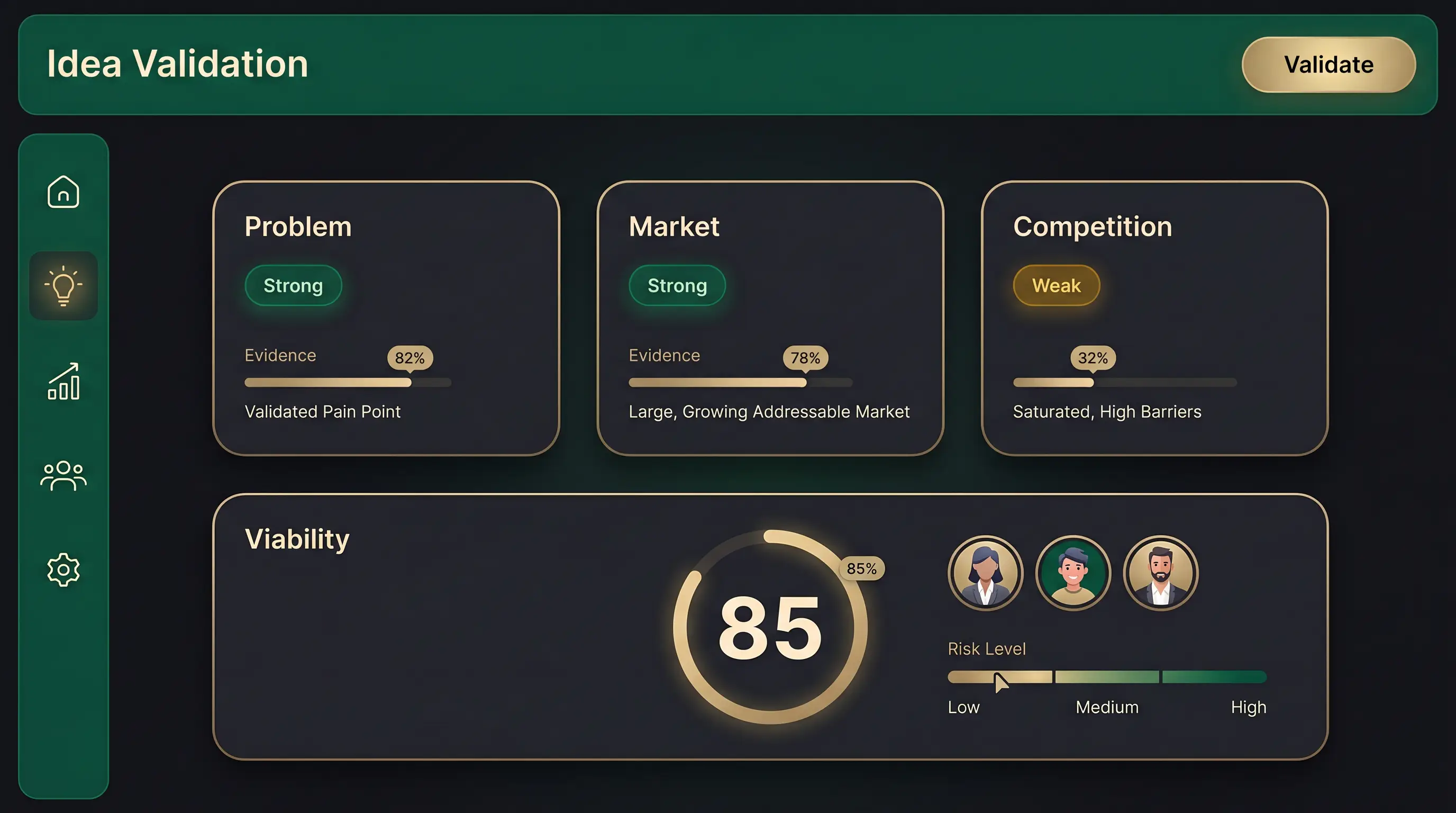
Startup Suite's Idea Validation is a structured way to test whether a founder's idea can become a monetised business. It is built to score the idea and to carry the same assumptions into your first forecast, so you don't re-enter them.
Idea Validation: test the economics before you commit
- Built to turn demand, pricing, and cost assumptions into a viability view.
- Designed to show how many customers you need to break even, and roughly when you reach them.
- Built to carry the tested assumptions into your first forecast.
Can a $120-a-month service break even?
Suppose a founder wants to sell a service at $120 per month, with a variable service cost of $35 per customer per month and fixed monthly costs of $8,500. Contribution margin per customer is 120 minus 35, which is $85. Break-even customers needed is 8,500 divided by 85, which is 100 customers.
Now assume the founder can win 15 customers a month at launch. With no churn, customer 100 arrives in month 7, which is when contribution first covers the $8,500. Losses build up on the way: months 1 to 6 bring in $26,775 of contribution against $51,000 of fixed costs, so the founder needs about $24,000 of cash, plus whatever it costs to win those customers.
Keep it honest: That does not prove the idea will work, but it turns the discussion into something testable. Mark early costs as assumptions and refine them as you learn.
Can your idea actually make money?
Frequently asked questions
What if I do not know my exact costs yet?
Start with ranges and mark them clearly as assumptions. Viability work is iterative by design.
Is break-even enough to prove viability?
No. It is necessary but not sufficient. You still need evidence of demand, customer access, and enough cash to keep going while you learn.
Should I validate the idea before I write the business plan?
Yes. Early market and economic validation makes the plan more credible.
Still have questions? Talk to the team.