From Idea to Financial Model: Build Your First One
At the earliest stage, a startup financial model is a short chain of calculations: a few assumptions about price, customers, churn and costs, turned into monthly revenue, cash and funding need. Investors and lenders want projections that clearly connect those numbers to your funding request.
· Updated · 5 min read

On this page
- Start with five drivers: price, growth, churn, costs and timing.
- Use assumptions you can defend out loud, and keep recurring and non-recurring revenue separate.
- Connect the model to cash needs and how the funding will actually be used.
- The model's job is to test whether the business could work and how much cash it needs first.
Start with drivers, not a blank sheet
Many first-time founders know their product idea but cannot translate it into numbers. They may know the price they want to charge, the customer they want to serve, and the team they think they need, but they do not yet have a model that links those assumptions into a forecast. That gap makes it hard to decide whether the idea is viable, how much cash is needed, or whether the plan is credible to others.
The fix is to start with drivers, not a blank spreadsheet. The core drivers of almost any early model are price, customer growth, churn or repeat behaviour, costs (headcount and major operating lines), and timing. Show monthly figures for the first year, and match the projections to the amount you are asking for.
- Price: what one customer pays, and how often.
- Growth: how many customers you add each month, and why.
- Retention: churn or repeat behaviour that compounds over time.
- Costs: headcount and the few large operating lines that actually move.
- Timing: when revenue is earned versus when cash arrives.
What a first model helps you decide
A first model answers practical questions before you raise money or hire people. It estimates profit, the month you break even, your startup costs and how payment timing affects cash. Each answer feeds a real decision, such as whether you can afford the next hire or when to start raising.
Where first models go wrong
- Starting from a detailed template the founder does not actually understand.
- Mixing one-time and recurring revenue in the same line.
- Forgetting startup costs entirely.
- Ignoring the timing difference between revenue earned and cash received.
- Using aggressive customer-growth assumptions without showing what drives them.
Watch out: Large models are especially hard to check. A wrong bottom-line figure can sit unnoticed for months, so make every output traceable to an input.
When a spreadsheet model gets hard to trust
A spreadsheet can absolutely help you prototype, but it becomes harder to trust once assumptions, scenarios, and outputs spread across tabs. The arithmetic is rarely the problem. Tracing it is: once a formula has been copied across tabs, a wrong number can sit unnoticed.
| Feature | Startup Suite | A spreadsheet |
|---|---|---|
| Speed | Structured around assumptions and connected outputs | Flexible for quick arithmetic |
| Reliability | Designed so logic traces from assumption to forecast | Easy to break with hidden formulas or copy and paste errors |
| Planning | Built to keep planning, scenarios, and investor-ready outputs connected | Often separates forecasting from the narrative plan |
- Speed
- Structured around assumptions and connected outputs
- Reliability
- Designed so logic traces from assumption to forecast
- Planning
- Built to keep planning, scenarios, and investor-ready outputs connected
- Speed
- Flexible for quick arithmetic
- Reliability
- Easy to break with hidden formulas or copy and paste errors
- Planning
- Often separates forecasting from the narrative plan
What an advisor can and cannot do for your model
An accountant or bookkeeper can check your model's structure and its tax lines. They can't make the pricing, growth and churn calls for you, and those are the numbers you will be asked to defend.
Building the model in Forecast Engine
Startup Suite's Forecast Engine is designed to give founders a guided way to turn assumptions into connected forecasts, without starting from a blank spreadsheet. It is built for the first model you can explain out loud: price, growth, costs, margin, runway, and funding implications in one place.
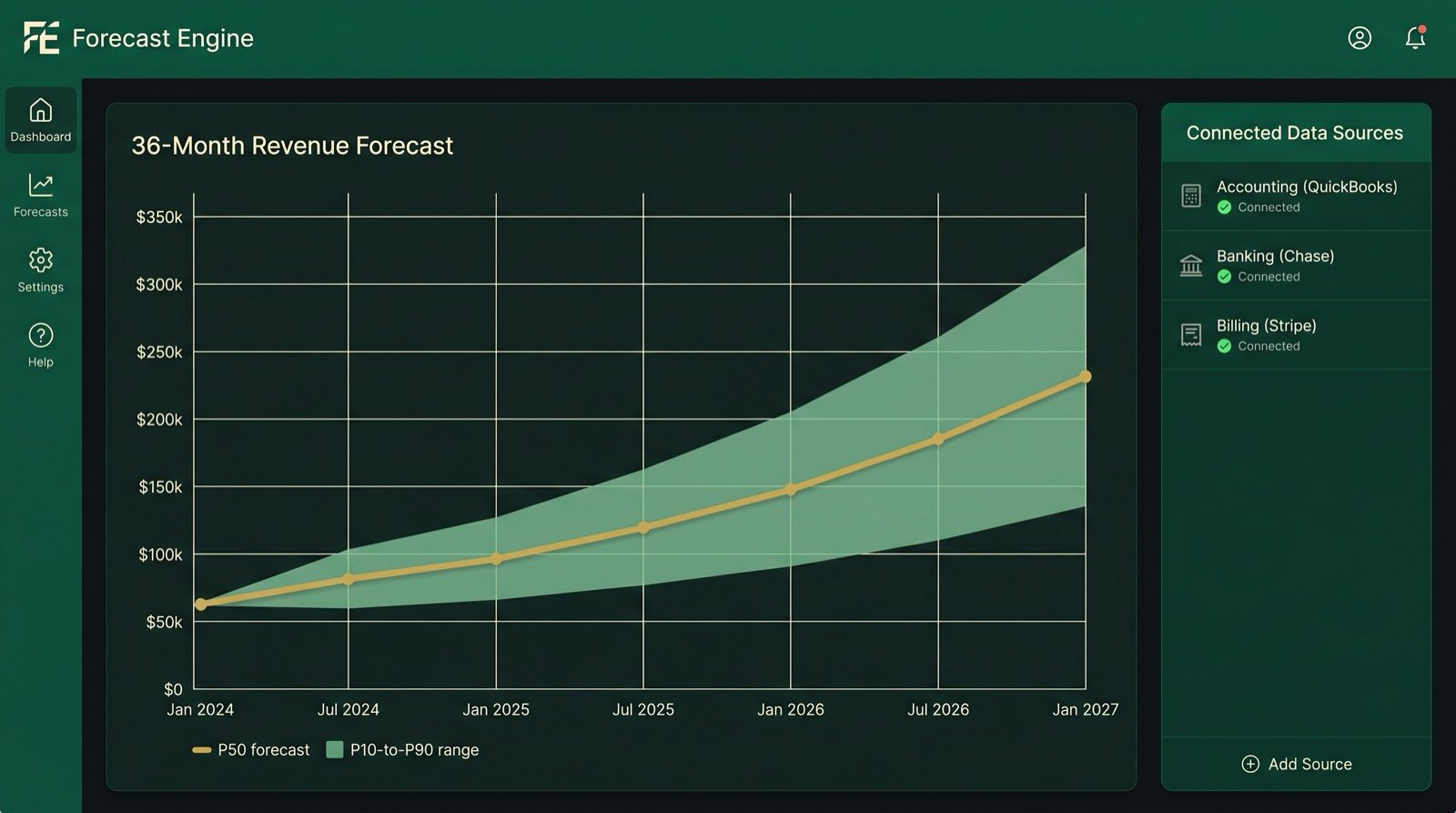
Forecast Engine: assumptions in, a defensible model out
- Built to connect revenue, cost, and cash outputs to a few drivers you enter.
- Each figure is built to trace back to an assumption you can edit.
- Designed to switch between a conservative and a growth scenario without rebuilding the model.
A $49-a-month product, month by month
Assume a founder plans to sell a software product for $49 per month, add 40 customers per month, and expects 3 percent monthly churn. Month-one MRR is 40 times 49, which is $1,960.
If month two adds another 40 customers and 3 percent churn applies to the month-one cohort, that cohort becomes 40 times 97 percent, or 38.8 customers. Month-two active customers are 38.8 plus 40, which is 78.8. Month-two MRR is 78.8 times 49, which is $3,861.20.
Why this matters: With $9,000 of fixed monthly costs, month two is still $5,139 short. Carry the same assumptions forward and MRR passes $9,000 in month 5, at about 188 customers. Until then the gap adds up to about $17,000, the cash this plan needs first (ignoring variable costs and payment delays).
From idea to a financial model
Frequently asked questions
What is the minimum a startup financial model needs?
At minimum: pricing, customer growth or sales volume, major costs, cash timing, and a view of profit or loss.
Do I need three financial statements from day one?
Not in full detail, but you do need a basic revenue view, cost view, and cash view so you can understand whether the business survives.
Is a spreadsheet always bad?
No. It is useful for quick calculations. The problem starts when the spreadsheet becomes the only operating system for planning and stops being easy to audit.
Still have questions? Talk to the team.