7 Financial Model Mistakes First-Time Founders Make
First-time models usually go wrong where an assumption was never written down or a formula can't be followed. If you can't show how an input becomes an output, you can't defend the output.
· Updated · 3 min read

On this page
- If you can't explain how an output was calculated, cut or simplify it.
- Spread annual contracts across their months for MRR, but show the full payment as cash in the month it arrives.
- Keep recurring and one-time revenue separate, and respect cash timing.
- Tie the model to the funding ask, and keep the first version small.
What goes wrong
The founder produces a model that looks detailed but falls apart at the first question, because nobody can show where a number came from.
The seven mistakes
- Starting too complex: dozens of tabs before you know your main drivers.
- Hiding assumptions inside formulas, such as a growth rate typed into a formula instead of a labelled input.
- Mixing one-time and recurring revenue, so a setup fee inflates MRR.
- Ignoring cash timing: treating invoiced revenue as cash before the customer has actually paid.
- Using heroic growth assumptions with no driver behind them.
- Forgetting downside cases, such as slower sales or a late hire.
- Failing to tie the model to the funding ask, so the raise doesn't match the burn the model shows.
How complex workbooks create false confidence
| Feature | Startup Suite | A spreadsheet |
|---|---|---|
| Confidence | Guided, traceable structure | Can produce false confidence through complexity |
| Errors | Designed to stay auditable | Error-prone in large linked models |
- Confidence
- Guided, traceable structure
- Errors
- Designed to stay auditable
- Confidence
- Can produce false confidence through complexity
- Errors
- Error-prone in large linked models
Cleaning up a model versus understanding it
A consultant can tidy the final model in a one-off review. If you can't explain the tidied version yourself, the first investor question about an assumption will show it, so build the model first and have it reviewed after.
Keeping the logic visible in Forecast Engine
Startup Suite's Forecast Engine is built to avoid invisible logic and keep the model explainable. Assumptions sit in their own labelled inputs, and the model is designed so each output can be traced to the input that drives it.
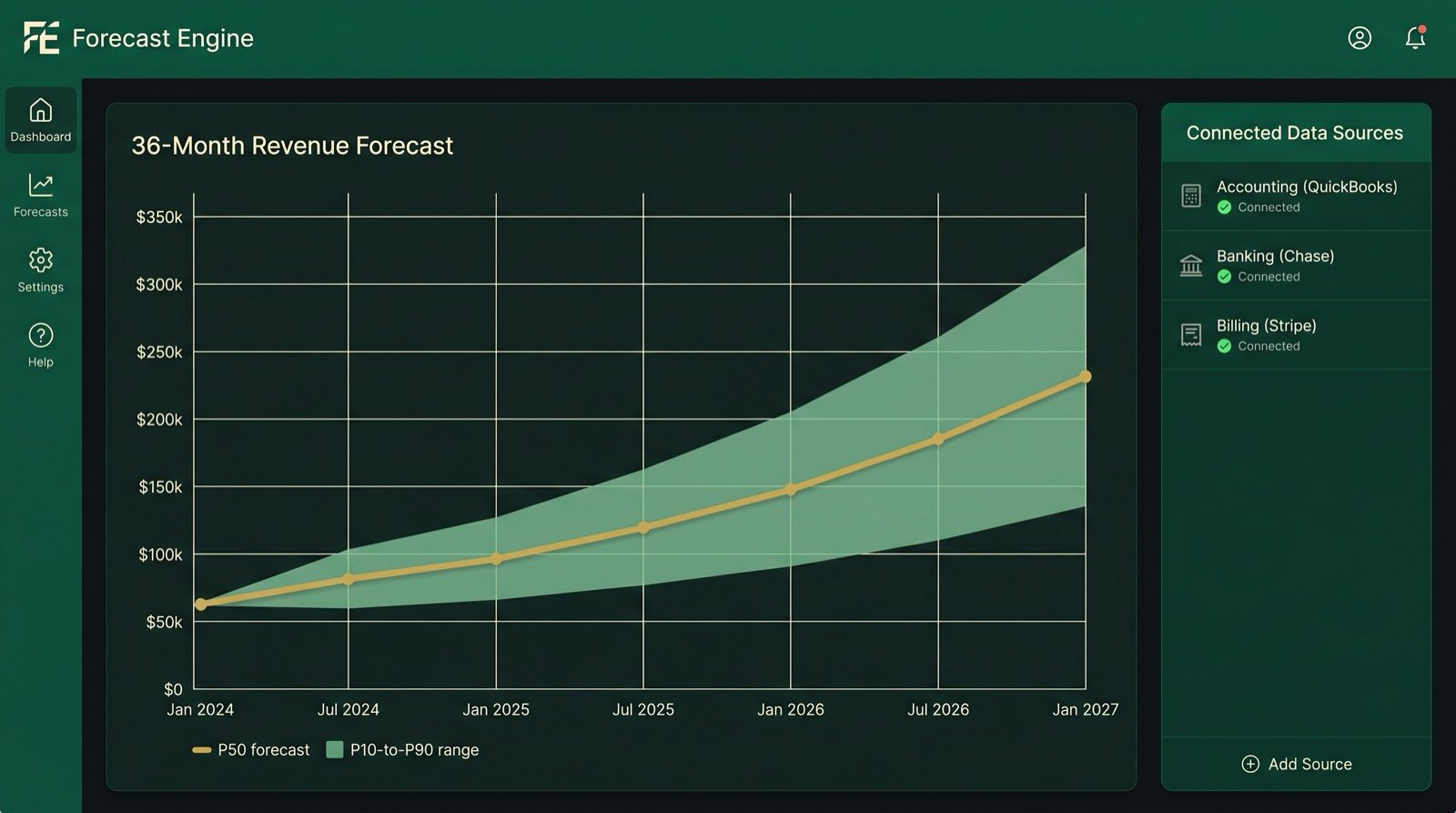
Forecast Engine: a model you can explain
- Built to keep assumptions visible instead of buried in formulas.
- Designed so any output traces back to the input that drives it.
- Start small and grow the model without losing auditability.
An annual prepayment counted as MRR
If a founder counts a full annual prepayment as first-month MRR, the forecast is distorted immediately. Spread annual contracts across the months they cover, so a $1,200 annual plan reads as $100 of MRR a month. The cash forecast still shows the full $1,200 in month one, because that is when you are paid.
The lesson: Keep two lines for this customer: $100 a month of revenue, and $1,200 of cash in month one. Show only one and you misstate either growth or runway.
7 financial model mistakes
Frequently asked questions
Is complexity a sign of quality?
No. A model is judged by whether it is understandable and traceable, not by how many tabs it has.
What is the most dangerous mistake?
Usually hidden logic or unsupported assumptions that nobody can verify.
Should first-time founders keep the first version small?
Yes. Start small, keep it explainable, and add detail only as you need it.
Still have questions? Talk to the team.