The 4 Forecasts Investors Expect
Investors want forecasts that answer their next questions: how fast you grow, what it costs, when cash runs short and what happens if growth slows. In practice that means four connected views: a revenue forecast, a profit and loss forecast, a cash-flow and runway forecast, and a scenario or sensitivity view.
· Updated · 4 min read

On this page
- Investors usually expect four connected views: revenue, profit and loss, cash and runway, and scenarios.
- Revenue can grow while cash falls: in this guide's example, $360,000 of revenue still leaves cash $80,000 lower at year-end.
- Revenue alone does not answer the funding question. Cash timing and margin do.
- Keep the views connected so a single assumption change flows through all of them.
What investors are asking
Founders often arrive with one headline number, such as ARR next year, but cannot show how that number affects cash, hiring, margin, or fundraising needs. Investors then have to reverse-engineer the business, and that lowers confidence fast.
When you seek financing, the usual request is projected income statements, balance sheets and cash-flow statements. The four views below cover the operating forecast, and the FAQ covers the balance sheet.
Why one headline number is not enough
A forecast is only useful if it answers the next question. Each view answers a question the one before raises: revenue shows scale, the P&L shows whether margins hold, cash shows when you need money, and scenarios show the risk.
The 4 forecasts
Revenue forecast: Shows how customers, pricing, conversion, retention, or sales volume create top-line revenue.
Profit and loss forecast: Shows whether gross profit and operating expenses support a viable model.
Cash-flow and runway forecast: Shows when cash enters and leaves the business, and whether timing creates funding pressure.
Scenario forecast: Shows what happens if growth is slower, costs rise, or pricing underperforms.
Keeping four forecasts in step
| Feature | Startup Suite | A spreadsheet |
|---|---|---|
| The four views | Built to keep the views connected | Holds them in separate tabs |
| In meetings | Designed to move from assumptions to outputs in one workflow | Harder to explain cause and effect quickly |
| Scenarios | Designed to compare best, base, and worst cases | Often weak on scenario communication |
- The four views
- Built to keep the views connected
- In meetings
- Designed to move from assumptions to outputs in one workflow
- Scenarios
- Designed to compare best, base, and worst cases
- The four views
- Holds them in separate tabs
- In meetings
- Harder to explain cause and effect quickly
- Scenarios
- Often weak on scenario communication
Fundraising prep versus a forecast you keep current
A consultant can help you prepare for a raise and improve the deck, usually as a set of milestone deliverables. The forecasts still need to stay current after the meeting and be revised as new information arrives, and that day-to-day work falls to the founder.
Presenting the forecasts in Investor Portal
Startup Suite's Investor Portal is designed to turn your assumptions into investor-ready forecast views. Every view is designed to draw on the same assumptions, so a follow-up question in the meeting can be answered by changing one input.
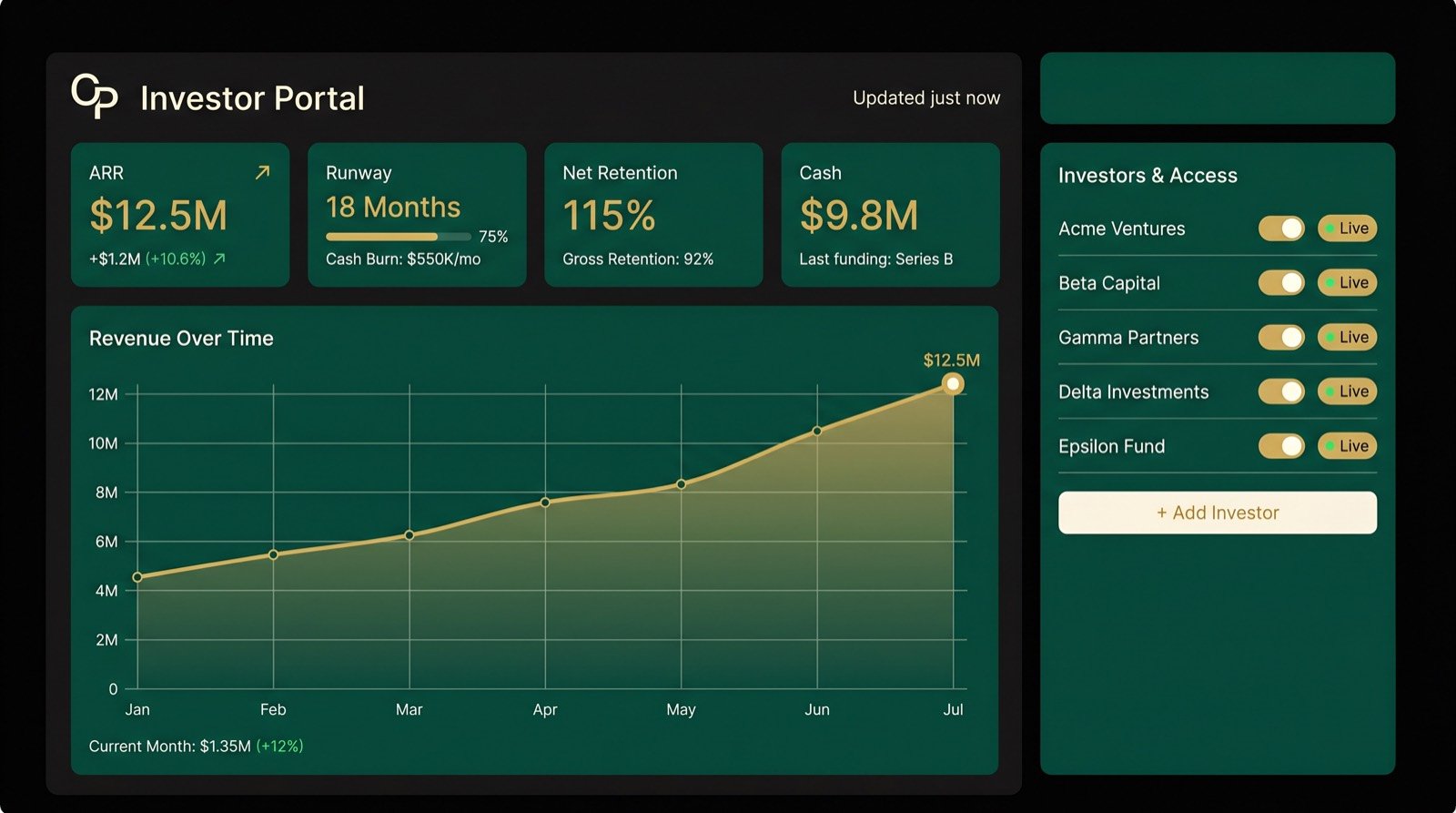
Investor Portal: forecasts that answer the next question
- Built to present revenue, profit and loss, cash, and scenarios from one connected model.
- Designed so a change to one assumption flows through all four views together.
- Built for updating the assumptions before each meeting, so the numbers match the latest plan.
When strong revenue hides a cash gap
Assume a founder projects revenue of $360,000 over the next 12 months, a 70 percent gross margin, operating expenses of $310,000, and opening cash of $150,000. Gross profit is 360,000 times 70 percent, which is $252,000. The operating loss is 252,000 minus 310,000, which is negative $58,000.
If working capital timing causes another $22,000 of cash strain, the year-end cash impact is negative 58,000 minus 22,000, which is negative $80,000. Expected ending cash becomes 150,000 minus 80,000, which is $70,000.
The point: Cash falls by $80,000 over the year, about $6,700 a month. If next year burns cash at the same rate, the $70,000 left at year-end lasts about 10 and a half more months. To start the next raise with six months of cash still in the bank, begin it about four months into next year.
The 4 forecasts investors expect
Frequently asked questions
Do investors always need a balance sheet too?
Often, yes, especially for a formal round or when debt is involved. A projected balance sheet follows from the P&L and cash-flow forecast, so build it from those. The four views above stay the core.
Are investor forecasts the same as lender forecasts?
They overlap, but lenders often focus even more heavily on repayment, collateral, and downside protection.
How detailed should the first year be?
Aim for monthly or quarterly detail in the first year, with clear explanations of the assumptions behind each line.
Still have questions? Talk to the team.