Stop Guessing: Validate With Real Numbers
To validate an idea with numbers, write down the chain from prospect to paying customer: how many people you can reach, what share book a call, what share buy, and what they pay. Each link is an assumption you can test cheaply before launch.
· Updated · 4 min read

On this page
- Write the funnel down: prospects reached, share who talk to you, share who buy, and what they pay.
- Set the result that would make you stop before each test, so you can reject bad assumptions early.
- User interest is not paying demand; measure both.
- Ten customers you can trace through a funnel tell you more than a share of a large market.
Turn belief into numbers you can test
It is easy to keep saying people want this without quantifying who those people are, what they would pay, or how many are needed to support the business. Validation replaces that with numbers you can test.
Turn qualitative belief into measurable assumptions:
- Qualified prospects you can reach
- Share who agree to a call or demo
- Share of those calls that close
- Average revenue per customer
- How long customers keep paying
Rejecting bad assumptions early
Before each test, write down the result that would make you stop or change course, for example 'fewer than 3 percent of prospects book a call'. Without a threshold set in advance, any result can be read as encouraging.
Validation mistakes to avoid
- Leaning on huge market-size narratives instead of reachable demand.
- Assuming a conversion rate instead of measuring one on real prospects.
- Confusing user interest with paying demand.
Losing the evidence behind the numbers
| Feature | Startup Suite | A spreadsheet |
|---|---|---|
| Workflow | Guided validation workflows | Good for quick arithmetic |
| Context | Built to keep evidence and assumptions aligned | Easy to lose assumption context |
- Workflow
- Guided validation workflows
- Context
- Built to keep evidence and assumptions aligned
- Workflow
- Good for quick arithmetic
- Context
- Easy to lose assumption context
Outside perspective versus your own iteration
Ask someone who already sells to your buyers whether your reach and call-booking rates look realistic. Then rerun the funnel yourself after every test, because each result changes which rate you should test next.
Validating in Idea Validation
Startup Suite's Idea Validation is built to record each funnel assumption alongside the evidence behind it, in one place instead of scattered notes and spreadsheets, and to feed the numbers you test into your model.
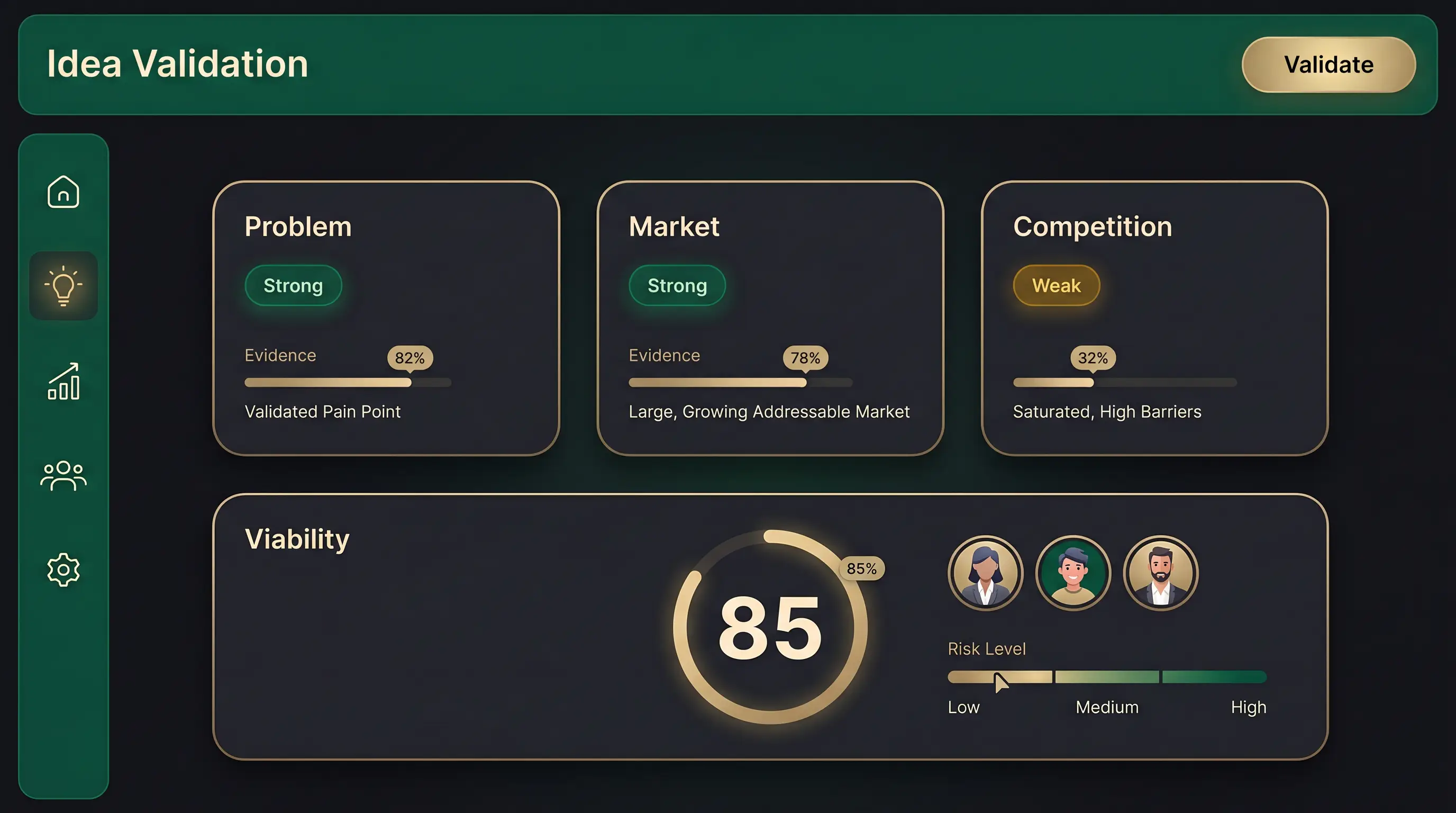
Idea Validation: assumptions you can defend
- Built to capture demand, conversion, and pricing as explicit, testable inputs.
- Designed to show the revenue those assumptions imply.
- Built to highlight which funnel rate your revenue depends on most, so you know what to test next.
From 500 prospects to 10 customers
If 500 qualified prospects see an offer, 8 percent schedule a call, and 25 percent of those calls close, customers acquired are 500 times 8 percent times 25 percent, which is 10 customers. If each pays $150 per month, monthly recurring revenue is 10 times 150, which is $1,500.
Why this helps: $1,500 of MRR is small, but every number in it can be checked. If 2 percent book a call instead of 8, you get two or three customers, not 10. Find out which rate is weakest and test that one first.
Validate with real numbers
Frequently asked questions
What numbers should I test first?
The top of the funnel: how many qualified prospects you can reach and what share agree to talk. Price and break-even come next, once you know people will engage.
Do I need real customers?
Not yet, but you need real prospects: book the calls and count how many close, even if the first sales are pilots or pre-orders.
Is total addressable market enough?
No. A market-size figure sets the ceiling. What matters this year is how many buyers you can reach, so size the funnel from prospects you can actually contact.
Still have questions? Talk to the team.