MRR, Churn, and NRR: Model a SaaS Business
A SaaS financial model typically starts with monthly recurring revenue, then layers churn, expansion, contraction, and retention. MRR is what subscribers pay you each month, churn is the share of customers or revenue lost each period, and net revenue retention is the MRR an existing group of customers pays you now, after expansion, contraction and churn, as a percentage of what they paid at the start.
· Updated · 3 min read

On this page
- Start with MRR, then layer expansion, contraction, and churn.
- Net revenue retention measures the revenue you keep from an existing base.
- Headline MRR can grow while the existing base shrinks; NRR below 100 percent is the sign.
- Handle annual plans and expansions carefully, since they distort naive MRR.
Track the movements behind MRR
A SaaS model rests on one line repeated each month: closing MRR = opening MRR + new + expansion − contraction − churn. Forecast each movement from its own driver, such as new MRR from leads and conversion, and churn as a share of opening MRR.
MRR: Monthly recurring revenue, what subscribers pay you each month, with annual plans spread across the months they cover.
Churn: The share of customers (logo churn) or of opening MRR (revenue churn) lost in a period. Say which one you mean.
Net revenue retention (NRR): Retained revenue from an existing base after expansion, contraction, and churn, shown as a percentage.
Where annual plans and expansion trip up spreadsheets
| Feature | Startup Suite | A spreadsheet |
|---|---|---|
| Tracking | Built to track MRR movements and NRR | Can calculate a single MRR figure |
| Edge cases | Built for recurring-revenue logic | Easy to mishandle annual plans or expansions |
- Tracking
- Built to track MRR movements and NRR
- Edge cases
- Built for recurring-revenue logic
- Tracking
- Can calculate a single MRR figure
- Edge cases
- Easy to mishandle annual plans or expansions
Three habits that distort MRR
Most MRR errors come from three habits: booking an annual plan in the month it's paid, counting one-off fees as MRR, and recording a downgrade as churn instead of contraction. Check each month's movements against invoices before trusting the trend.
Reading retention in Benchmark Library
Startup Suite's Benchmark Library is built for recurring-revenue planning and designed to put your MRR, churn and NRR alongside illustrative reference ranges, so you can read retention quality as well as growth. The ranges are reference points, not promises about your business.
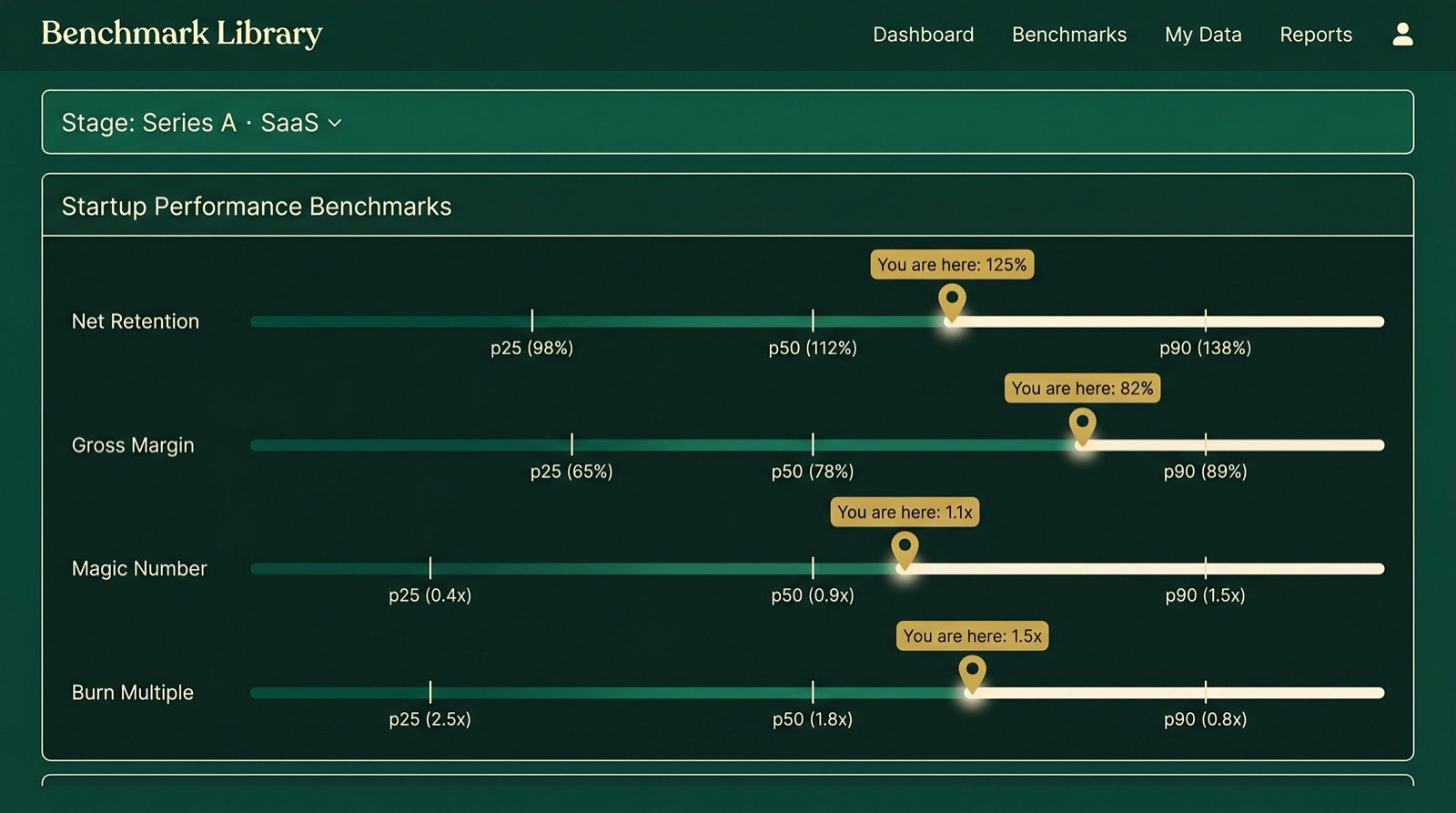
Benchmark Library: recurring-revenue clarity
- Built to track MRR movements: new, expansion, contraction and churn.
- Designed to show net revenue retention against illustrative ranges.
- Meant to surface weakening retention before the headline growth hides it.
Calculating a 100 percent NRR
Take the customers who were paying you 12 months ago, when their MRR was $20,000. Over the year, expansion added $2,500, contraction removed $900 and churn removed $1,600. New customers are left out: NRR only measures the base you already had. The ending retained revenue from the original base is 20,000 plus 2,500 minus 900 minus 1,600, which is $20,000.
Net revenue retention is 20,000 divided by 20,000, which is 100 percent.
Why NRR matters: A 100 percent NRR means expansion exactly offset losses. Above 100 percent, the existing base grows on its own. Below, you are leaking revenue even before adding new customers.
MRR, churn, and NRR
Frequently asked questions
What is a good NRR?
Above 100 percent means the base grows without new sales. Check gross revenue retention too (NRR without expansion): a few large upgrades can hide broad churn.
How are annual plans handled in MRR?
Spread the annual amount across the months it covers rather than booking it all in month one.
Is growth alone enough?
No. Strong growth with weak retention is fragile, which is why churn and NRR sit next to MRR.
Still have questions? Talk to the team.