Pricing You Can Defend in the Room
Defensible pricing is a price you can explain with evidence: what alternatives cost, what the buyer gains, and the margin you need. Add how price changes affect demand, then choose a number you can justify in the room.
· Updated · 3 min read

On this page
- Defensible pricing answers four questions: alternatives, buyer value, margin needed, and demand sensitivity.
- Pricing shapes revenue, margin, break-even timing, and fundraising needs.
- A higher price can win even when sign-ups fall, if contribution per customer rises faster.
- Test a price on real prospects before launch and feed the close rate back into the model.
Four questions defensible pricing answers
Founders often pick a number that feels right and then struggle when lenders, investors, or customers ask why. Defensible pricing usually answers four questions:
- What alternatives cost
- What value the buyer gets
- What gross margin you need
- How price changes affect demand
How price moves the whole plan
Pricing shapes revenue, margin, break-even timing, and fundraising needs. In the example below, a $10 price rise lifts contribution per customer by half, from $20 to $30. That flows straight into break-even, runway and how much you need to raise.
Pricing mistakes founders make
- Setting price from your costs instead of the buyer's value.
- Copying a competitor's price without knowing their costs or customers.
- Ignoring the cost to serve each customer.
Testing a price in isolation
| Feature | Startup Suite | A spreadsheet |
|---|---|---|
| Testing price | Built to link pricing changes to full scenario outcomes | Easy to test price cells in isolation |
| Telling the story | Designed to show each price option's effect on margin and runway side by side | Hard to show why one price beat another |
- Testing price
- Built to link pricing changes to full scenario outcomes
- Telling the story
- Designed to show each price option's effect on margin and runway side by side
- Testing price
- Easy to test price cells in isolation
- Telling the story
- Hard to show why one price beat another
How to test a price before launch
You can test price before launch: quote different prices to comparable groups of prospects, or quote higher on new deals and track the close rate. Feed the result back into the model as your conversion assumption.
Comparing price options in Scenario Workbench
Startup Suite's Scenario Workbench is built to compare pricing options against margin, runway and growth assumptions in one place, so the price you choose is one you can defend with numbers.
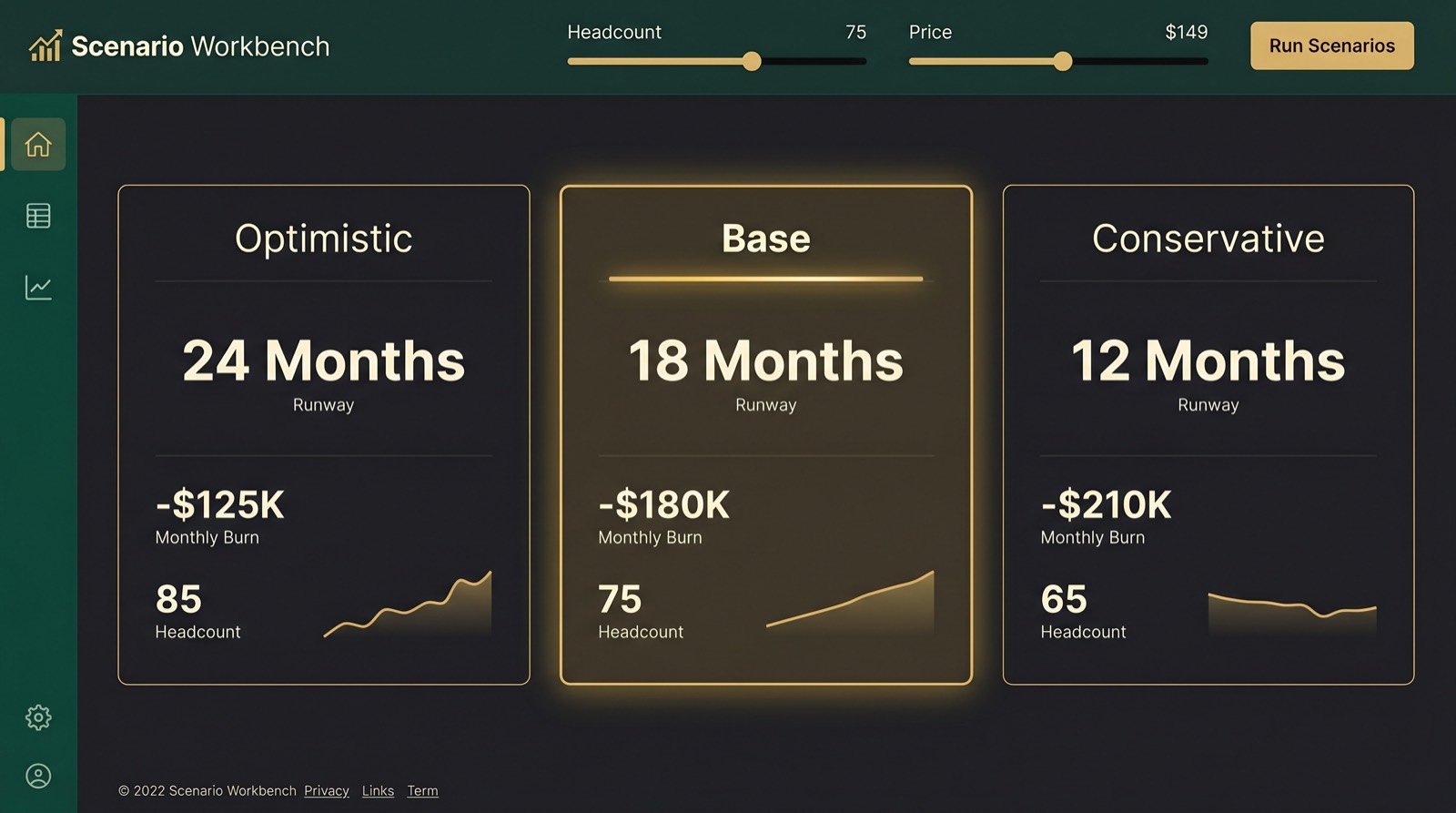
Scenario Workbench: pricing you can justify
- Built to compare price points against contribution margin and runway.
- Designed to show how a price change ripples through demand and cash.
- Walk into the room with the reasoning behind the number.
$29 or $39: running both prices
If price is $29, monthly customers acquired are 50, and variable cost per customer is $9, then revenue is 50 times 29, or $1,450, and contribution is 50 times 20, or $1,000.
If price rises to $39 and acquisitions drop to 38, revenue is 38 times 39, or $1,482, and contribution is 38 times 30, or $1,140.
The insight: Sign-ups fell 24 percent and contribution still rose, because each customer now contributes $30 instead of $20. The $39 price wins as long as you sign at least 34 customers a month (1,000 divided by 30). If acquisition spend stays the same, CAC rises too, so check payback as well.
Pricing you can defend
Frequently asked questions
Should I always charge more?
Not necessarily. The model should test both demand and contribution before you decide.
Do I need competitor pricing?
Yes, but it is only one input among value, margin, and demand sensitivity.
Can early founders change pricing later?
Usually yes. Raising prices for new customers is easy; raising them for existing customers is harder, so start near a price your value evidence supports.
Still have questions? Talk to the team.