Unit Economics, Explained for Founders
Unit economics tells you whether one customer, one order, or one subscription contributes enough value to justify the cost of acquiring and serving it. In recurring-revenue businesses, CAC, LTV, and churn are the common shorthand, and an LTV to CAC ratio of 3 to 1 (a customer worth three times what it cost to win) is often cited as a healthy target.
· Updated · 4 min read

On this page
- Unit economics asks whether a single customer is worth more than it costs to win and serve.
- Track CAC, LTV, the LTV to CAC ratio, and payback period together.
- Use gross margin, not revenue, for LTV, and include all of sales and marketing in CAC.
- LTV of three times CAC is a commonly cited target, not a rule.
The four numbers to read together
Founders can grow revenue while losing money on every added customer. Unit economics catches that early. The basic checks are four numbers you read together:
- CAC, sales and marketing spend divided by new customers won.
- LTV, the gross profit a customer brings in before they churn.
- The LTV to CAC ratio.
- Payback period, how long it takes to earn back CAC.
Efficient growth versus expensive growth
These metrics show whether growth is efficient or just expensive. Take two companies whose customers each bring in $80 a month of gross profit. If one paid $500 to win each customer and the other paid $1,500, the first earns back its spend in about six months and the second in about 19.
Unit economics mistakes
- Using revenue instead of gross margin for LTV.
- Excluding salaries from CAC.
- Ignoring churn, which quietly shortens LTV.
When CAC loses some of its costs
| Feature | Startup Suite | A spreadsheet |
|---|---|---|
| Over time | Designed to track and compare metrics across months | Can calculate core ratios once |
| Completeness | Structured metric tracking | Easy to miss components of CAC |
- Over time
- Designed to track and compare metrics across months
- Completeness
- Structured metric tracking
- Over time
- Can calculate core ratios once
- Completeness
- Easy to miss components of CAC
Why to recalculate every month
Recalculate monthly. CAC drifts up as cheaper channels fill, and churn moves LTV fast: at 5 percent monthly churn the same customer is worth $1,600, not $2,000.
Checking ranges in Benchmark Library
Startup Suite's Benchmark Library is built for cross-checking your unit economics against illustrative reference ranges and seeing which lever matters most. The ranges give context, not promises about your specific business.
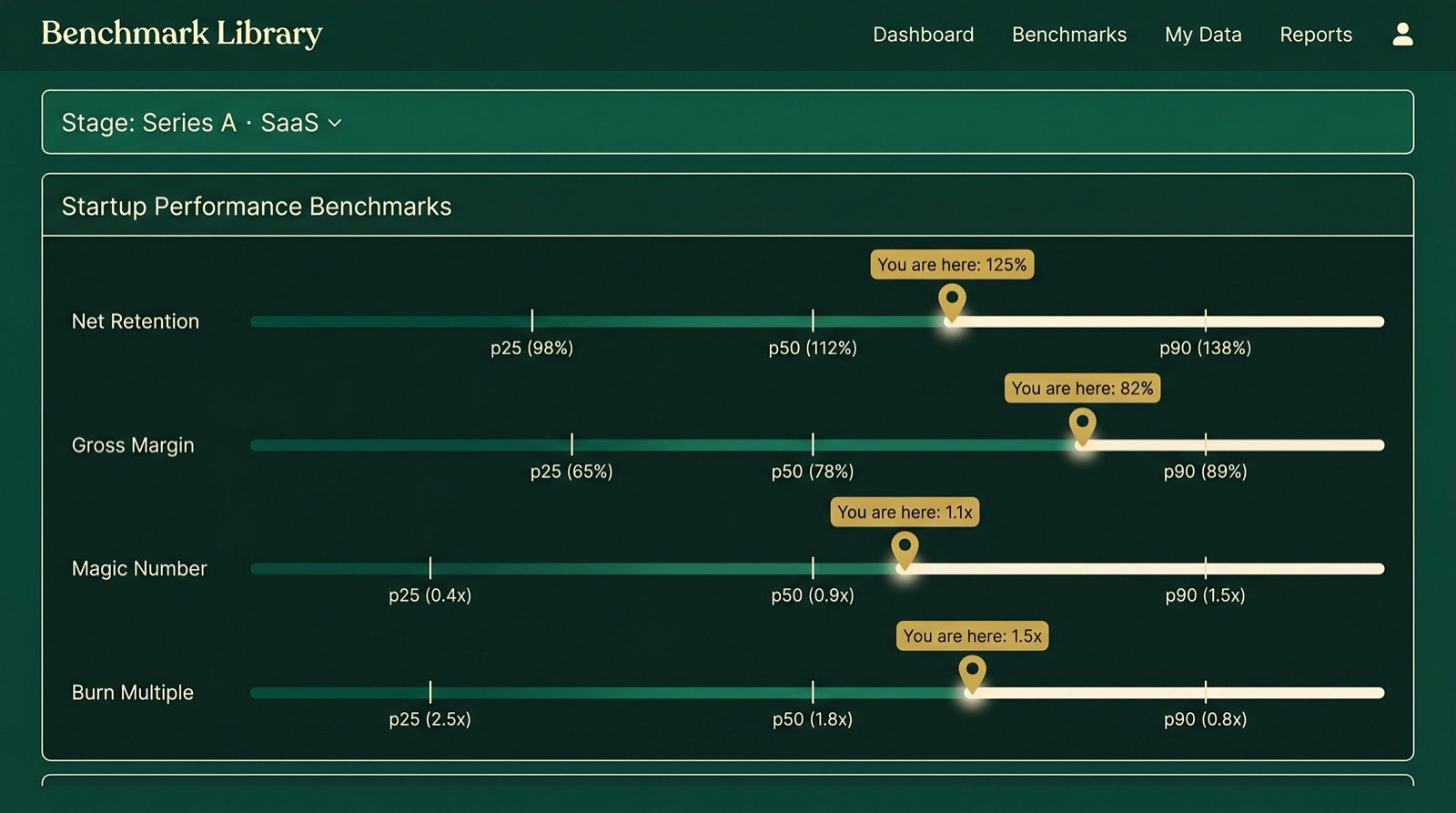
Benchmark Library: context for your metrics
- Designed to show CAC, LTV, and payback alongside illustrative ranges.
- Built to point out which lever moves the ratio most: acquisition cost, margin or churn.
- Built to track the metrics month by month instead of recomputing them by hand.
Working out CAC, LTV and the ratio
Suppose marketing and sales spend in a month is $12,000 and you add 24 customers, so CAC is 12,000 divided by 24, or $500. If average monthly gross profit per customer is $80 and monthly churn is 4 percent, a simple LTV estimate is 80 divided by 4 percent, or $2,000.
LTV to CAC is 2,000 to 500, or 4 to 1. Payback period is CAC divided by monthly gross profit per customer: 500 divided by 80, about 6.3 months.
Reading it: Each customer returns four times what it cost to win and pays back in about six months. At 4 percent monthly churn the average customer stays about 25 months (1 divided by 0.04), so the cost is recovered well before they leave.
Unit economics, explained
Frequently asked questions
Is LTV always exact?
No. It is an estimate and depends heavily on churn and margin assumptions.
Does CAC include founder time?
Formal CAC often leaves it out. If you do most of the selling, add an estimate of your time at what a salesperson would cost, or CAC will jump when you hire one.
Is a 3 to 1 LTV to CAC ratio always the goal?
No. It is a commonly cited target, not a law that fits every business.
Still have questions? Talk to the team.