Best, Base, Worst: Scenario Planning for Founders
Scenario planning for founders means comparing a small number of plausible operating cases rather than pretending one forecast is certain. Change a few critical assumptions, then compare runway and the decisions it drives in a best case, a base case and a worst case.
· Updated · 4 min read

On this page
- Plan on the base case, check you survive the worst case, and use the best case to see what faster growth would cost.
- Change only a few drivers at first, starting with the ones that move runway most.
- Scenarios show the range of plausible outcomes and which actions matter most if the worst case starts to show.
- A scenario earns its place when it changes a decision, such as delaying a hire or starting a raise earlier.
Why one forecast hides the risk
A single forecast hides uncertainty, and founders then make hiring or fundraising decisions as if the future were settled. A good starting set is a best case, a base case, and a worst case. Start with the assumptions that move cash most: how many customers you win each month and at what price, how many you lose to churn, and your largest costs.
Preparing for a range of outcomes
Decide in advance what you will do if the worst case starts to show: which hire you would delay, which spend you would cut, and how much earlier you would start raising. A scenario is only useful once it has a trigger and an action.
A simple scenario set
Suppose monthly new customers are 40, 30, or 20 across the three cases, with price constant at $60. New monthly MRR added is $2,400 in the best case, $1,800 in the base case, and $1,200 in the worst case. The $600 monthly gap builds up: after six months the worst case is 60 sign-ups behind base, which is $3,600 less MRR every month, before churn.
When scenario tabs get messy
| Feature | Startup Suite | A spreadsheet |
|---|---|---|
| Comparing cases | Built to compare scenarios side by side | Scenario tabs are possible |
| Switching assumptions | Designed for controlled assumption switching | Manual setup gets messy quickly |
- Comparing cases
- Built to compare scenarios side by side
- Switching assumptions
- Designed for controlled assumption switching
- Comparing cases
- Scenario tabs are possible
- Switching assumptions
- Manual setup gets messy quickly
When to rerun your scenarios
Rerun the three cases before each hire or large commitment, before board meetings, and whenever actuals sit below the base case for two months running.
Comparing cases in Scenario Workbench
Startup Suite's Scenario Workbench is built for comparing cases before an expensive decision. It is designed so you set up the three cases once, then read the effect on runway and funding timing side by side.
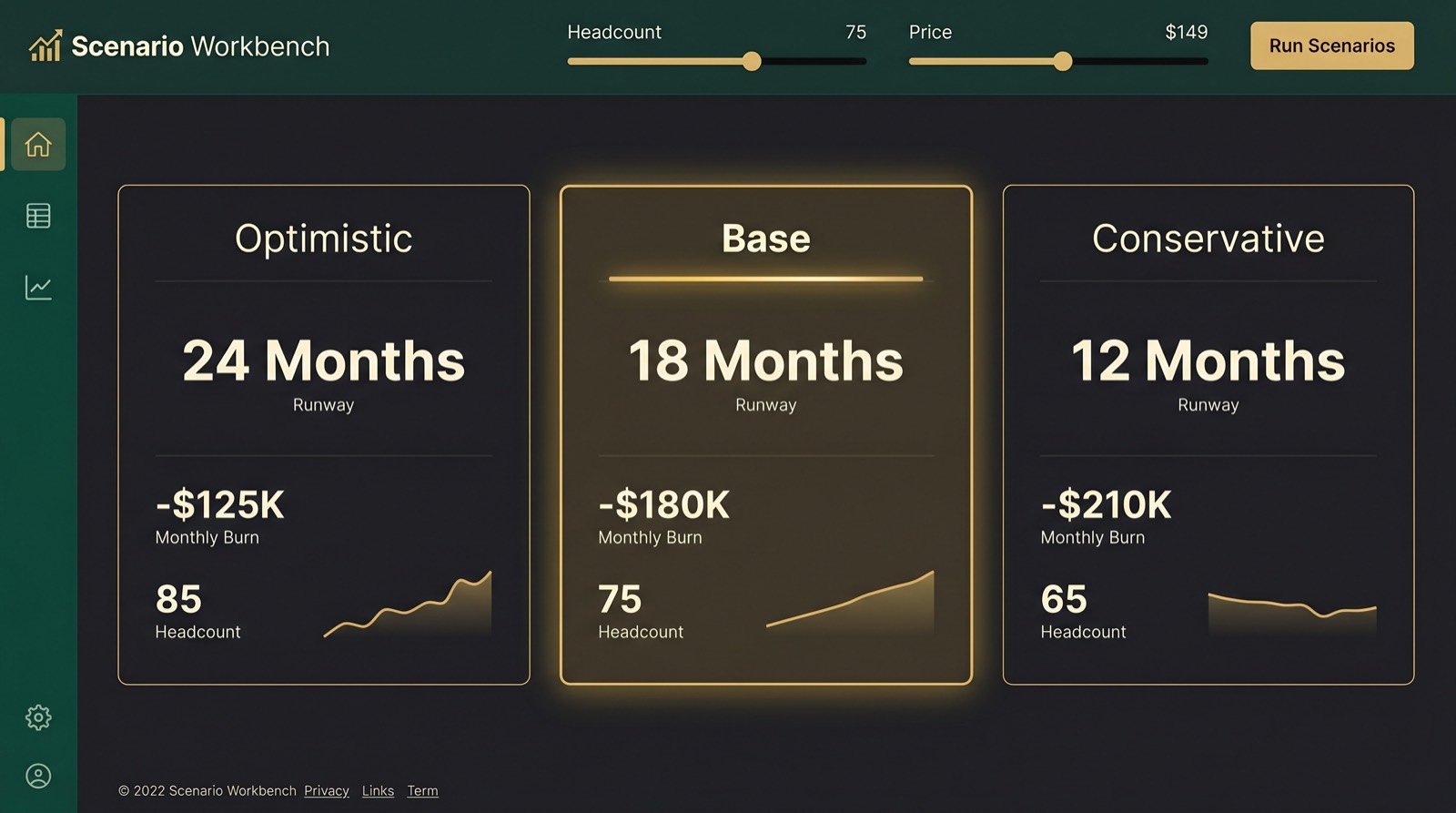
Scenario Workbench: decide with the range in view
- Built to compare all three cases on the same screen.
- Built so a change to one driver carries through every case.
- Designed to show how each case changes runway before you commit to a hire or a raise.
A five-month swing in runway
Say base-case net burn is $12,000 a month and worst-case burn is $18,000. With $180,000 in the bank, runway falls from 15 months (180,000 divided by 12,000) to 10 months (180,000 divided by 18,000), assuming burn stays flat.
The decision: If a raise takes six months to close, the base case lets you start in month 9, but the worst case means starting by month 4. That is the decision a single forecast hides.
Best, base, worst
Frequently asked questions
How many scenarios do I need?
Three to start: the case you plan on, one where things go worse and one where they go better.
Should all assumptions change at once?
No. Change one driver at a time first, so you can see which one moves runway most. Then combine the bad ones for the worst case.
Is the best case for investors?
Not by itself. Investors also want to see clear downside thinking.
Still have questions? Talk to the team.